Is ChatGPT finding more of the web now?
Get the 5 AI search links every Tuesday
Hi, Tanya here.
You're getting this because at some point you signed up for something from Rankingonai.com: the APEX checklist, the AI search video, a playbook, or the newsletter itself. Every week my team shares the 5 links that actually mattered in AI search, and this is the first one landing in your inbox. If you'd rather not get these, there's an unsubscribe link at the bottom, no hard feelings.
I'm in Singapore this week! On Thursday I'm heading to Profound's Zero Click conference, which is all about AI search. If you're going too, come say hi. And if you know someone in Singapore I should grab a coffee with, just hit reply and intro us.
I respond to every email, so feel free to hit reply. Below are the 5 links my team found most useful this week, with one thing to do for each, plus 3 charts: two from the sites we work on and one from this week's links.
This week in 30 seconds
- Is ChatGPT finding more of the web now?
- Does robots.txt actually stop AI from using your content?
- What does AI share of voice really tell you?
- How does DeepSeek's new search API score websites?
- Is Google rewriting what AI Overview citations say?
This week in numbers
Two charts from the 10 sites we have worked on for the full last 6 months (weekly GA4 data, Apr 27 to Oct 25, 2026, all AI engines combined unless stated), plus one from this week's links.
AI search visits to the sites we manage almost doubled in 6 months
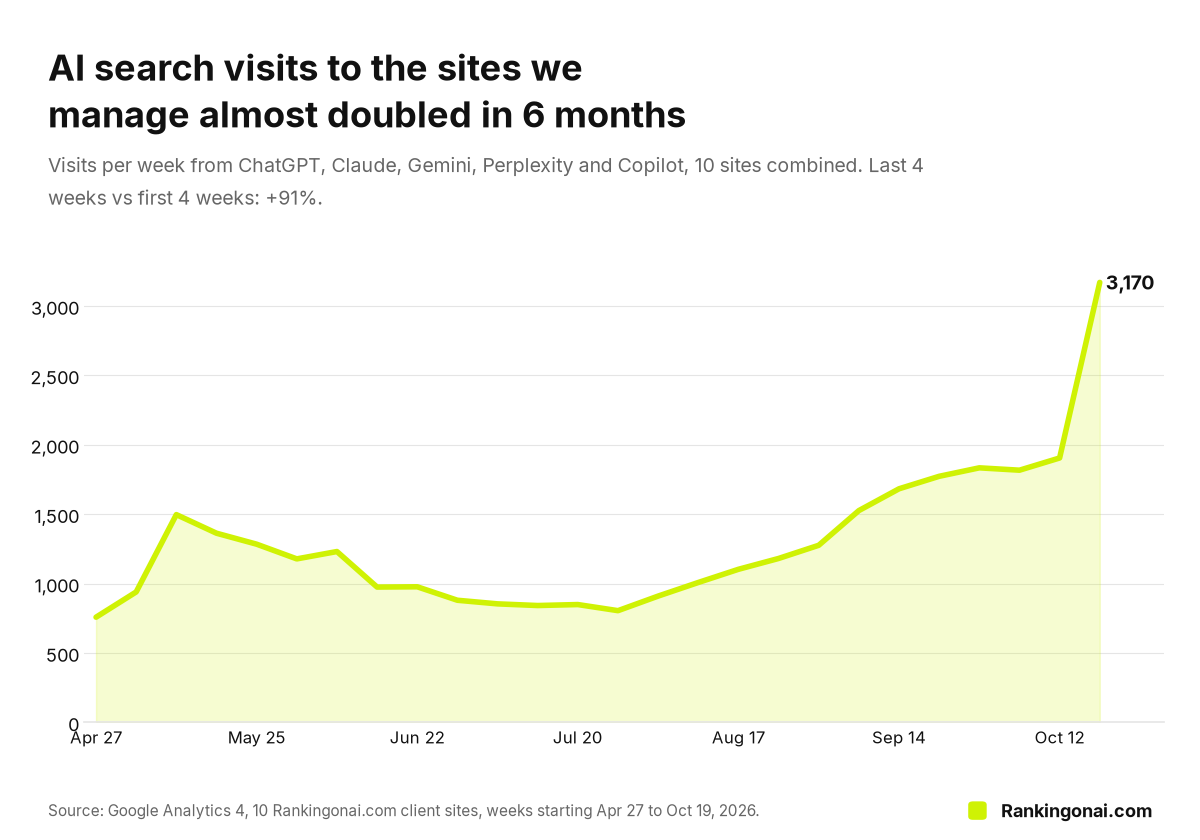
Source: Google Analytics 4, 10 Rankingonai.com client sites, weeks starting Apr 27 to Oct 19, 2026.
ChatGPT sends 56% of AI search visits. Claude is number two at 34%
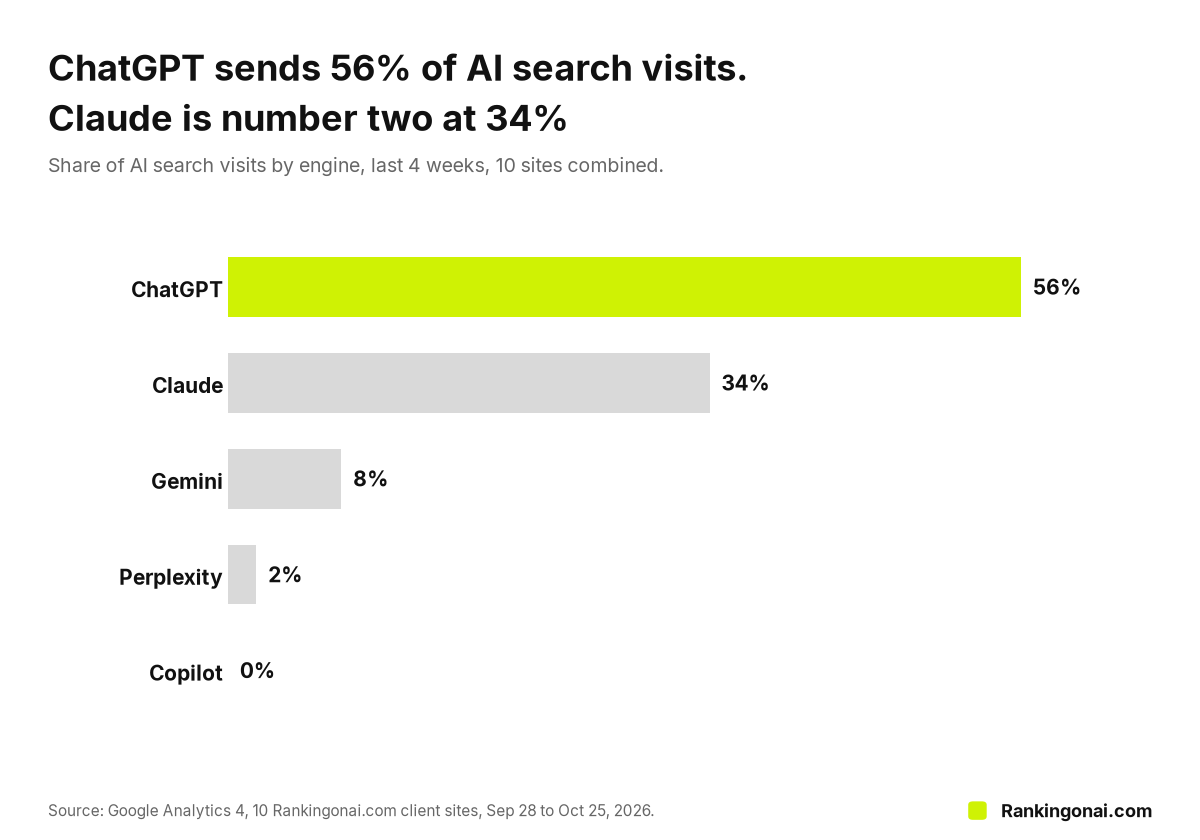
Source: Google Analytics 4, 10 Rankingonai.com client sites, Sep 28 to Oct 25, 2026.
ChatGPT sees about 115 prompts for every 1,000 Google searches. Gemini and Perplexity see about 10
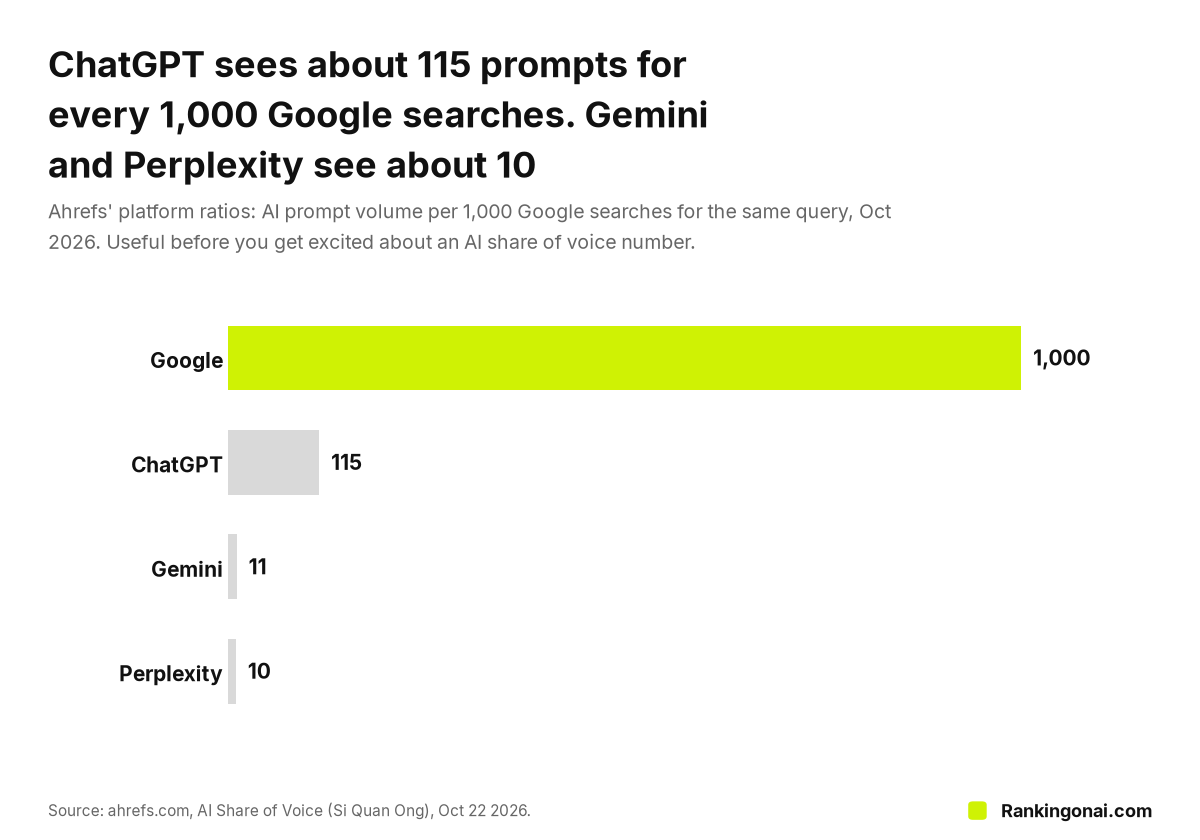
Source: ahrefs.com, AI Share of Voice (Si Quan Ong), Oct 22 2026.
Is ChatGPT finding more of the web now?
Search Engine Journal · Oct 20
Possibly, yes. Search Engine Journal that a Cloudflare and OpenAI pilot, covering about 1% of Cloudflare's network, helped OpenAI discover and index hundreds of millions of new pages for ChatGPT search. Here's the thing: finding a page is not the same as citing it, and the companies gave no numbers on citations or traffic.
Why it matters: More discovery gives newer and smaller pages a better chance to be seen, but OpenAI still ranks pages on its own.
What to do: Check your robots.txt. Allow OAI-SearchBot if you want to appear in ChatGPT search, and choose a GPTBot (training) rule on purpose.
Does robots.txt actually stop AI from using your content?
Search Engine Journal · Oct 22
Not by itself. SEJ reports that Google's Gary Illyes said robots.txt is about access, not about what a system does with content after it crawls it. To block a specific AI crawler, you have to name its user agent.
Why it matters: A made-up directive just gets ignored. If you believe you opted out of AI training, you may not have.
What to do: Open your robots.txt and list which AI user agents it names. Remove any line that depends on a rule no crawler reads.
What does AI share of voice really tell you?
Ahrefs · Oct 22
Less than the number suggests. Ahrefs defines it as your brand's share of AI mentions against tracked competitors, across a set of prompts, and says the score is only as meaningful as the way it is calculated.
Why it matters: It shows relative visibility. It does not show traffic, sentiment or sales, and a different prompt set gives a different score.
What to do: Fix one prompt set and one competitor list for your brand and report the same setup every month. Split the score by platform and topic before you share it.
How does DeepSeek's new search API score websites?
Suganthan Mohanadasan · Oct 19
Early look only. Suganthan's test ran DeepSeek's new Search and Fetch API for a day from one location. Each result came back with an authority tier and a rerank score, and authority appeared to be set per host. He calls the numbers directional.
Why it matters: Another AI search engine is opening to developers, and its authority score may follow your whole domain, not single pages.
What to do: Treat it as a source to watch, not a finding. Check that your key pages carry machine-readable dates, since undated results dropped out of date-filtered searches in his test.
Is Google rewriting what AI Overview citations say?
Search Engine Roundtable · Oct 23
It looks that way. Search Engine Roundtable that Brodie Clark spotted AI-written summaries inside AI Overview citation cards, text that does not appear word for word on the cited page. Barry Schwartz saw it on some of his test queries, not all.
Why it matters: The snippet that earns the click may now be Google's own paraphrase of your page, so a plainly written page matters more than a clever meta description.
What to do: Run your top 5 queries and read the citation card. If the summary is off, tighten the opening lines of the page so the answer is stated plainly.
That's this week. Which one should I go deeper on? Just reply.
Tanya