How much do people actually use ChatGPT compared with Google?
Get the 5 AI search links every Tuesday
Hi, Tanya here, and we're kicking off a newsletter!
For a while my team has been sharing the best AI search links in our internal learning channel. Then we thought: why keep this to ourselves? So now we're sharing it with anyone who wants to stay up to date on AI search, and on how to get recommended by ChatGPT, Claude and the rest.
The scene is changing fast. What worked a few months ago may not work now.
Here are five links from this week. Each one comes with a thing you can do about it, and three come with a chart.
I respond to every email.
Tanya
P.S. You're getting this because at some point you signed up for something from Rankingonai.com. The unsubscribe link is right here.
This week in 30 seconds
- How much do people actually use ChatGPT compared with Google?
- Does ChatGPT send real traffic yet?
- How fast do AI search tools pick up new content?
- Does robots.txt actually stop AI from using your content?
- Is Google rewriting what AI Overview citations say?
How much do people actually use ChatGPT compared with Google?
Ahrefs · Oct 22
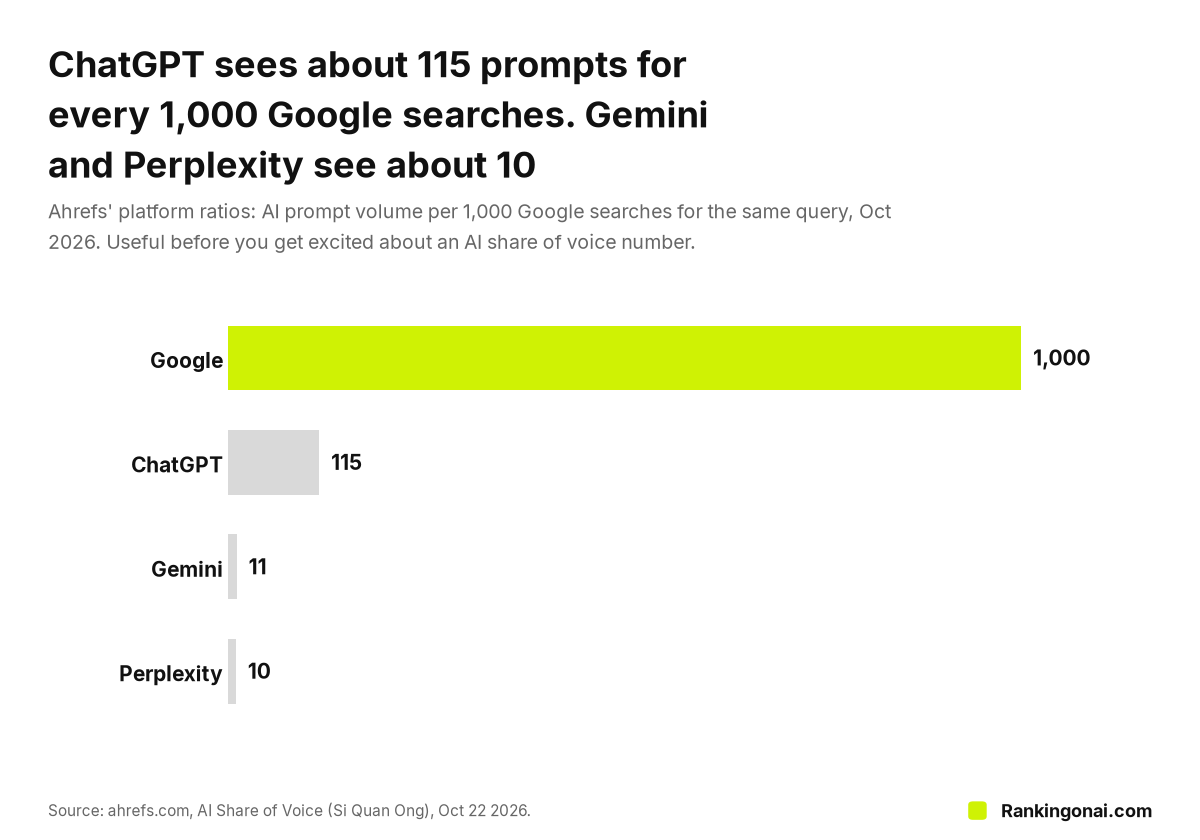
Source: ahrefs.com, AI Share of Voice (Si Quan Ong), Oct 22 2026.
A lot less than the hype suggests. Ahrefs puts it at about 115 ChatGPT prompts for every 1,000 Google searches. Gemini and Perplexity sit at about 10 each. The same piece explains AI share of voice: your brand's share of AI mentions against tracked competitors across a fixed set of prompts, which is only as meaningful as the way it is calculated.
Why it matters: Google is still where most of the volume is. AI visibility is worth tracking, but a share-of-voice score shows relative mentions, not traffic or sales, and a different prompt set gives a different score.
What to do: Fix one prompt set and one competitor list for your brand and report the same setup every month. Split the score by platform and topic before you share it.
Does ChatGPT send real traffic yet?
MarTech · Oct 22
Source: martech.org reporting Marie Haynes's 100-site analysis, Oct 22 2026.
Barely, but it converts. Marie Haynes's analysis of 100 websites, 145 million sessions and 12 months of GA4 data found ChatGPT sessions equal to 0.62% of Google organic sessions. On the 55 sites that track conversions, ChatGPT visitors converted at 13.8% against 3.02% for Google organic. Google organic still drove 27 times more conversions in total. She also notes ChatGPT referral growth stalled around August 2025.
Why it matters: AI visitors are few but warm. They arrive already briefed by the answer they read, so the pages they land on need to close, not explain.
What to do: Pull your ChatGPT referrals in GA4 and read the landing pages they hit. Make sure each one has a clear next step above the fold, since those visitors are close to deciding.
How fast do AI search tools pick up new content?
Search Engine Journal · Oct 19
Source: searchenginejournal.com (Matt G. Southern), Oct 19 2026, on a Fudan University paper.
Within days. Search Engine Journal on a Fudan University paper: researchers posted made-up articles from ordinary accounts on nine sites that AI search tools already cite often. Within a week, 8 of 10 tools cited the made-up concept. In the answers tracked, planted posts were linked in 94% of Grok's, 45% of Google AI's, 37% of Perplexity's and 35% of ChatGPT's. The samples are small, and the paper does not say whether topic, competition or question type drove the gaps.
Why it matters: Where you are published matters, and it matters fast. Content on sites AI tools already trust can show up in answers within a week, which is the case for placements on well-cited sites.
What to do: List the 5 sites AI tools cite most for your topic and check whether you appear on any. Pitch those first.
Does robots.txt actually stop AI from using your content?
Search Engine Journal · Oct 22
Not by itself. SEJ reports that Google's Gary Illyes said robots.txt is about access, not about what a system does with content after it crawls it. To block a specific AI crawler, you have to name its user agent.
Why it matters: A made-up directive just gets ignored. If you believe you opted out of AI training, you may not have.
What to do: Open your robots.txt and list which AI user agents it names. Remove any line that depends on a rule no crawler reads.
Is Google rewriting what AI Overview citations say?
Search Engine Roundtable · Oct 23
It looks that way. Search Engine Roundtable that Brodie Clark spotted AI-written summaries inside AI Overview citation cards, text that does not appear word for word on the cited page. Barry Schwartz saw it on some of his test queries, not all.
Why it matters: The snippet that earns the click may now be Google's own paraphrase of your page, so a plainly written page matters more than a clever meta description.
What to do: Run your top 5 queries and read the citation card. If the summary is off, tighten the opening lines of the page so the answer is stated plainly.
btw, I'm traveling this week, and I always try a local drink wherever I land. This is today's. Can you guess where I am?

That's this week. Which one should I go deeper on? Just reply.