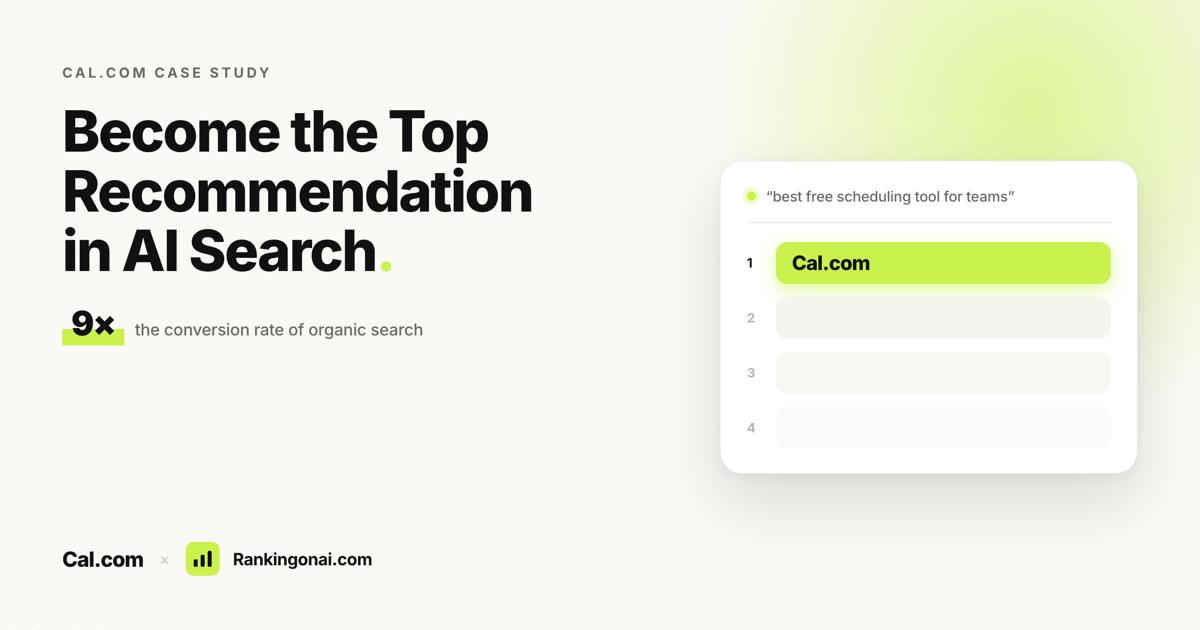
Cal.com Case Study: How Cal.com Became the #1 Recommendation in AI Search
How Cal.com became the top recommendation in ChatGPT, Claude and Perplexity, and why about 1 in 3 of its sales meetings now come from AI search. Includes the full interview.
On this page
- At a glance
- Watch the interview
- The full story
- What does “number one” mean in AI search?
- The recommendations are not a black box.
- AEO VS SEO
- The content strategy: bottom of funnel first
- Where we place content outside the client's own site
- Why publishing a thousand AI articles can hurt more than it helps
- The content prune, and what it did for Cal.com
- Parasite SEO, including the move we'd make with a $100 budget
- Track revenue per article, then stop trying to track everything
- Who should own AI visibility inside the company
- Starting from zero: the three things we would do first
- This channel is close to winner take all
- What To look for when hiring for SEO
- Frequently asked questions
- Full interview transcript
At a glance
- Client: Cal.com, open source scheduling infrastructure for teams and businesses.
- Stage: Growing from about $5M to $10M ARR when we started working together.
- Goal: Become the brand AI assistants recommend when buyers ask for a scheduling tool, and turn that into sales pipeline.
- Result: Cal.com became the top recommendation in its category across ChatGPT, Claude and Perplexity for the searches we track.
- Pipeline: About 1 in 3 meetings in Cal.com's sales motion now come from AI search. That share has roughly tripled since we started.
- What we did: bottom of funnel comparison pages and scoped listicles, a content prune, placements in listicles that already rank, YouTube, and revenue tracking per article.
Watch the interview
Ryan, who runs go-to-market at Cal.com, sat down with Tanya to walk through what drove the result. The full transcript is at the bottom of this page.
The full story
What does it take to be the number one recommendation on an AI search engine?
RankingOnAI.com works across SEO, GEO and AEO, and Cal.com gives us a real example of what that work can look like.
Since we started working with Cal.com as a SaaS Ai Search agency, it has become the top recommendation in its category across the major AI assistants. Ask ChatGPT, Claude or Perplexity for the best free calendar scheduling tool and Cal.com comes back first across the searches we track.
The impact has also started showing up further down the funnel. Ryan, who runs go-to-market at Cal.com, told us that roughly one in three meetings coming through the sales motion now comes from AI search. That share has roughly tripled since we started working together.
So what did we actually change?
This is a deep dive into the work behind that result: how we approached Cal.com’s AI visibility, where we focused our efforts, what didn't work, and what helped Cal.com reach the top of AI search.
What does “number one” mean in AI search?
AI search results aren't fixed in the same way a Google ranking is. The answer can change depending on the prompt, the platform, and when you run the search.
That makes AI visibility harder to measure than a traditional search ranking. A screenshot tells you what an assistant said at one point in time. It doesn't tell you whether the same result keeps appearing across the searches that matter.
For Cal.com, we track a set of commercial prompts across the major AI assistants and look at how consistently the brand appears, where it appears, and which sources are being used to support the recommendation.
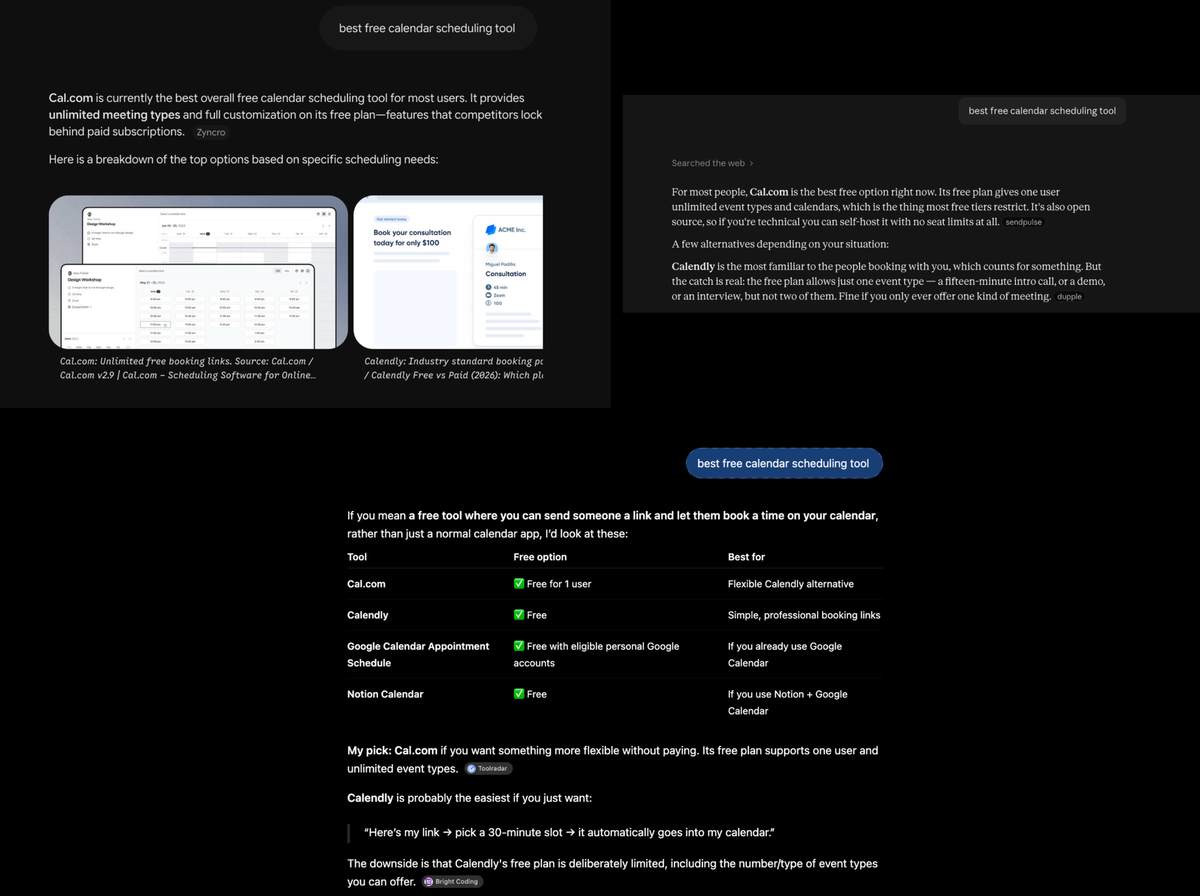
Once we started looking at the sources behind AI answers, we could see what information was actually feeding into the recommendations and where there were opportunities to influence them.
The recommendations are not a black box.
When ChatGPT gives you an answer, you can see the sources it used. Open the More actions menu and select View sources.
We started doing this regularly while working on Cal.com. One answer about scheduling tools had around 50 sources behind it.
Some were predictable. Cal.com's own pricing page was cited for details about its free plan. Others were more interesting. Competitor websites showed up too, including pages that compared different scheduling tools. The model was using those pages to build its understanding of the category, even when the site itself wasn't the final recommendation.
And then there were the odd ones.
In one run, a listicle about the best calendar scheduling software for tarot readers appeared in the sources.
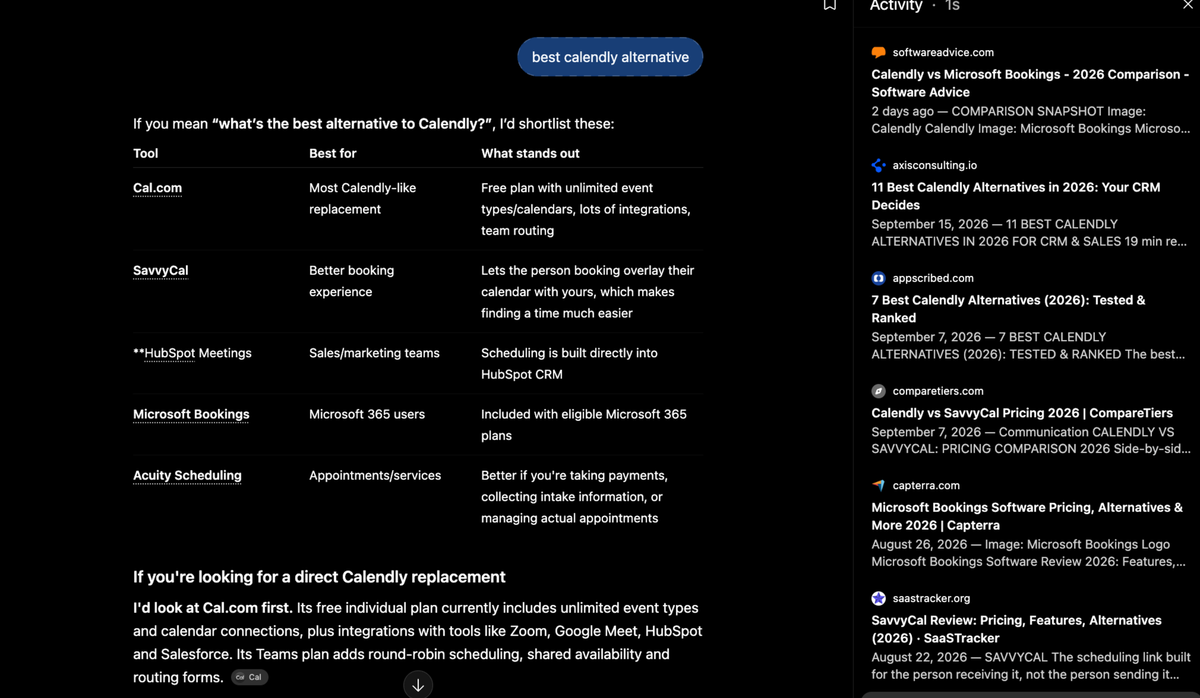
That tells you something important about how AI search works. The sources behind a recommendation aren't limited to the websites you'd expect to matter. The model is pulling together information from across the web, including pages targeting very specific searches and audiences.
So instead of guessing what ChatGPT might be looking at, we started looking at the sources ourselves.
That became a big part of the Cal.com strategy: find the sources influencing the answers, understand why they are being used, and build the kind of presence that gives AI search more reasons to recommend Cal.com.
AEO VS SEO
There’s a lot of debate about whether AI search is a completely new discipline or just SEO under a different name.
Our experience with Cal.com has made the answer fairly straightforward: a lot of the fundamentals are the same.
You still need to be visible in the places people are looking. You still need information about your company to be clear, accurate and easy to understand. And you still need other sites to mention and link to you.
What has changed is where some of that work happens and what seems to carry more weight.
For us, three things stood out:
- Structured data isn't the main lever: Schema and FAQ markup still have their place, but they aren't where we'd put most of the effort if the goal is to influence AI recommendations.
- Third-party mentions matter more: AI search doesn't just learn about a company from its own website. It pulls information from comparison pages, reviews, directories, industry sites and other places where a company is mentioned.
- The type of content matters more: Getting traffic to a page isn't the same thing as getting a buyer to consider your product. We wanted to focus our content on the searches where someone is actually choosing between products.
We stopped trying to cover the whole calendar scheduling category and started concentrating much more heavily on bottom-of-funnel searches: comparisons, alternatives and tightly defined “best” searches where the person already knows what they need and is deciding which product to use.
The content strategy: bottom of funnel first
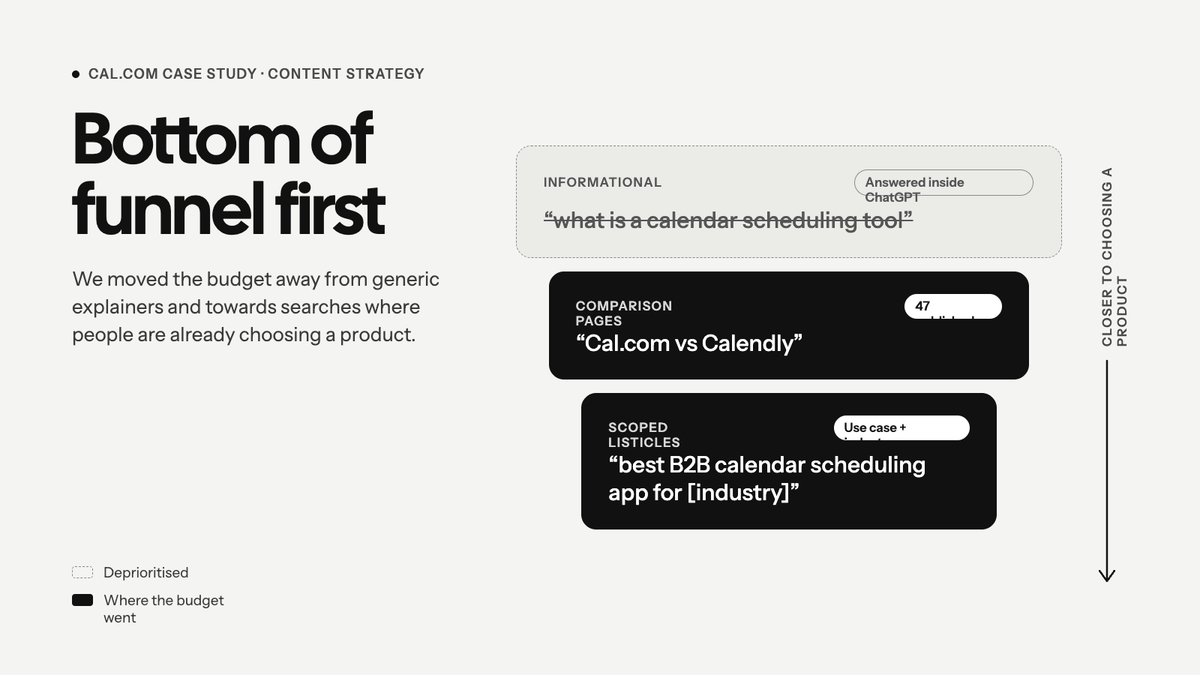
We stopped putting much effort into generic informational content for Cal.com and shifted the budget towards comparisons and tightly scoped listicles.
That is probably the biggest strategic decision we made on the account.
The reason is fairly straightforward. Someone searching “what is a calendar scheduling tool” is still very early in the buying process. Someone searching “Cal.com vs Calendly” or “best calendar scheduling tool for [specific use case]” is much closer to choosing a product.
We wanted more of the second type of search.
Comparison pages:
A post on X that reverse engineered Cal.com's AI visibility counted 47 comparison posts on the site. That count is accurate, and the author was right to identify comparison content as a major part of the strategy.
We have pages comparing Cal.com with SavvyCal, Calendly and other named competitors.
The important part is how those pages are written. They need to give the reader enough information to make an actual decision. That means covering the differences properly and being willing to say where the competitor is a better fit.
A comparison that gives Cal.com the win on every single point doesn't help anyone. It reads like marketing copy, and there is little reason for a model to treat it as a useful source.
Scoped listicles:
The X post missed another large part of the strategy: how much “best of” content we publish.
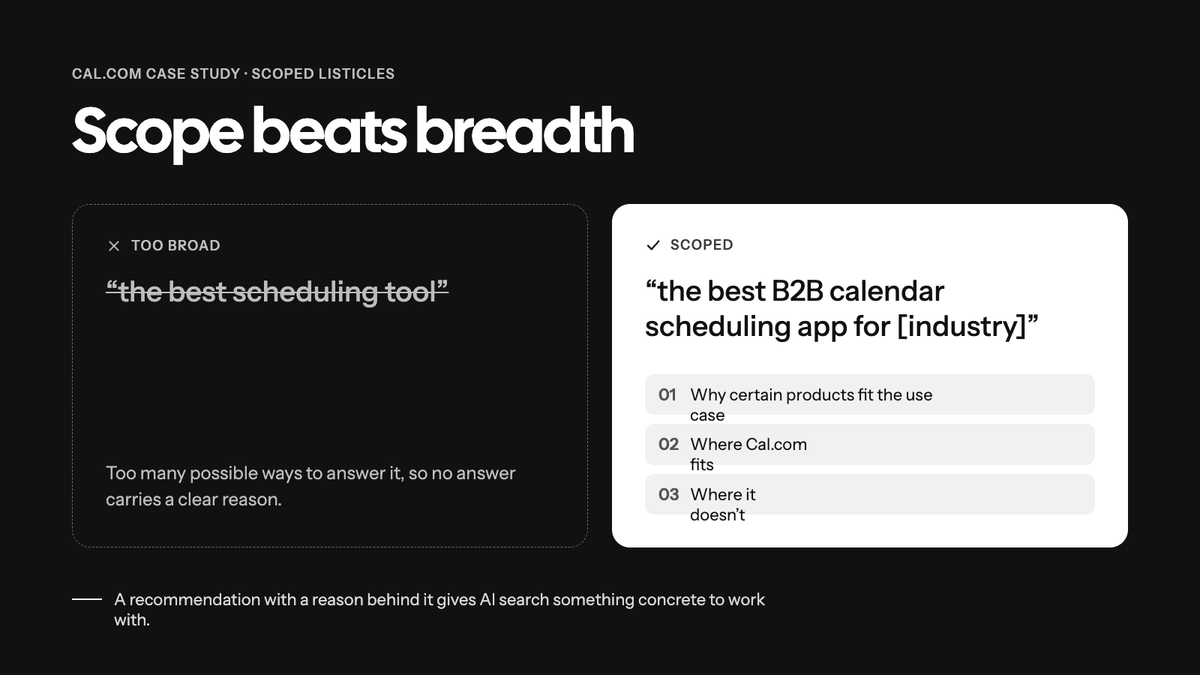
We don't spend much time trying to rank for something as broad as “the best scheduling tool.” There are too many possible ways to answer that question.
Instead, we go after specific use cases and industries:
the best B2B calendar scheduling app for [industry]
That gives us a much more useful page to build. We can explain why certain products fit that use case, where Cal.com fits, and where it doesn't.
This kind of content also gives AI search something concrete to work with. The recommendation has a reason behind it.
Why we dropped informational content
Generic informational content used to be a reliable way to bring people into the site. Someone searches “what is a calendar scheduling tool,” reads the explanation, clicks around the site and eventually signs up.
A lot of that journey now happens inside the search result.
ChatGPT can explain the category. The user may never need to visit the page.
And even when they do, someone searching a basic definition isn't necessarily looking for a scheduling product yet.
So we stopped spending much of the content budget on that part of the funnel. The focus went towards searches where someone is already comparing products or looking for a recommendation.
That is where we saw the strongest opportunity to get Cal.com into the conversation.
Where we place content outside the client's own site
Some of the most useful work happens away from the client's domain.
For Cal.com, two areas have been particularly useful: YouTube and existing listicles that already rank for relevant searches.
Reddit, and why we moved away from it
Reddit was everywhere in AI search through late 2025 and early 2026. It was being cited heavily in ChatGPT, helped in part by the OpenAI data partnership.
That created an obvious problem. Once everyone noticed, everyone started trying to manufacture mentions.
The platform responded with tighter moderation, comment rate limits and more archived threads. The opportunity we were seeing earlier became much harder to scale.
We still monitor Reddit. If there is a thread getting traction around a relevant use case, we'll get involved. But we don't treat Reddit as a major part of the strategy anymore.
That is fairly normal in SEO. A tactic works, people pile into it, the platform changes something, and the economics change with it.
YouTube is where we'd spend now
YouTube is a different story.
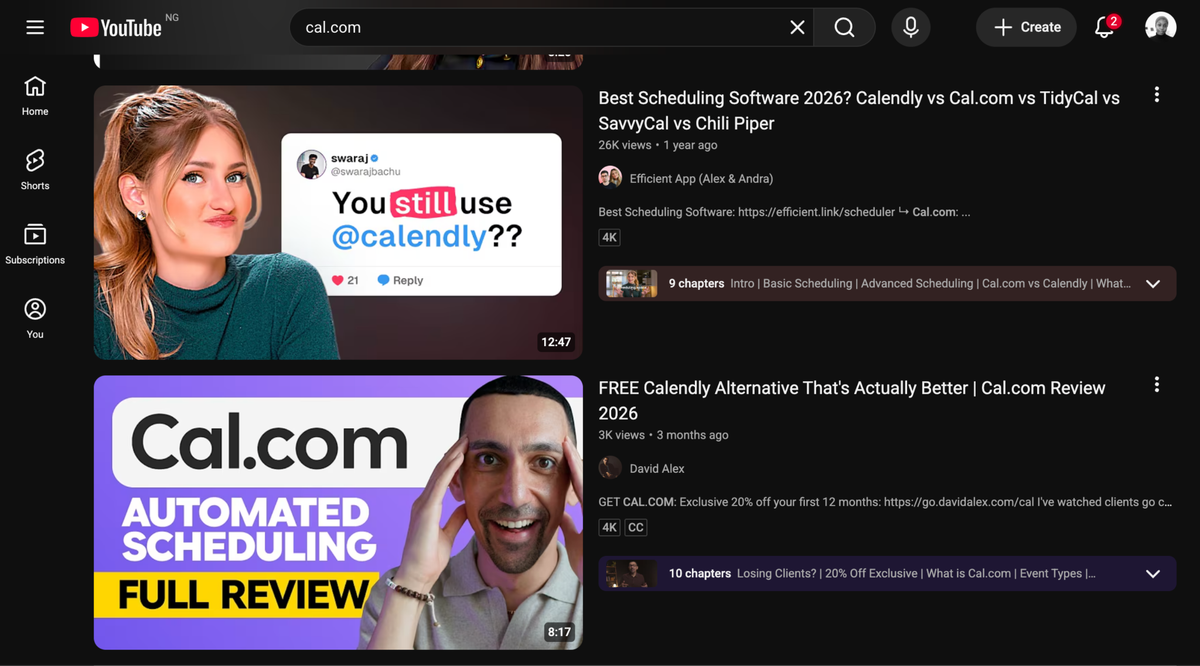
Ahrefs analysed 75,000 brands and found a strong correlation between YouTube brand mentions and AI visibility. They counted a mention when a brand appeared in a video's title, description or transcript. YouTube had the strongest correlation they measured, at roughly 0.74, compared with 0.66 for branded web mentions and 0.22 for backlinks. The study covered ChatGPT, Google AI Mode and AI Overviews.
That's enough for us to take YouTube seriously.
We've started running creator partnerships, commissioning videos that actually cover the product, and treating those videos as part of the search strategy rather than a separate brand awareness exercise.
Getting into listicles that already rank
We did this early with Cal.com and have kept doing it.
We worked to get Cal.com included in existing roundups of scheduling tools, including a HubSpot article, and have continued that outreach since.
The appeal is pretty simple. The page already ranks. It already has authority. It may already be getting read by the AI systems we're trying to influence.
Getting Cal.com mentioned on that page can therefore do more than publishing another article on Cal.com's own site.
That doesn't make the client's website irrelevant. It means we're dealing with a much bigger web than the client's website.
The idea that you can win AI search by tweaking a landing page for ChatGPT misses a large part of what is happening. The landing page is one source. The model can look at dozens of others.
So we want Cal.com mentioned in the places those models are already finding and using.
LinkedIn is the next channel we're paying more attention to. We expect it to become a bigger part of the mix, particularly as AI search continues to pull information from public professional content.
Why publishing a thousand AI articles can hurt more than it helps
There is a big difference between using AI to help produce content and using it to fill a website.
We use AI much more in production now than we did a year ago. But there is still a lot of work around every article: deciding what deserves a page, checking whether we've already covered the topic, making sure the page has a clear purpose, linking it properly, and having someone actually review what was written.
The other approach is easy to spot. Generate hundreds of articles, publish them automatically and move on to the next batch.
We see sites doing this all the time. The pages often have little connection to the company's actual expertise, overlap with each other, have no clear author, and aren't connected properly to the rest of the site. A large number never get meaningful organic visibility.
There are a few problems with that approach:
Author information still matters
A page with a real author, a useful bio and evidence of relevant experience gives readers more information about who is behind the content.
That becomes particularly important when a site is publishing at scale. If hundreds of articles appear with no author or editorial ownership, there is very little for a reader to use to assess where the information came from.
We don't solve that by adding a fake author bio to an AI article. The person attached to the content needs to have a real connection to the subject.
Publishing similar pages creates its own problem
Take a keyword like “best calendar scheduling tool for med spas.”
If you publish five pages targeting essentially the same search, you've created five URLs competing for the same opportunity.
We'd rather have one strong page with a clear primary keyword.
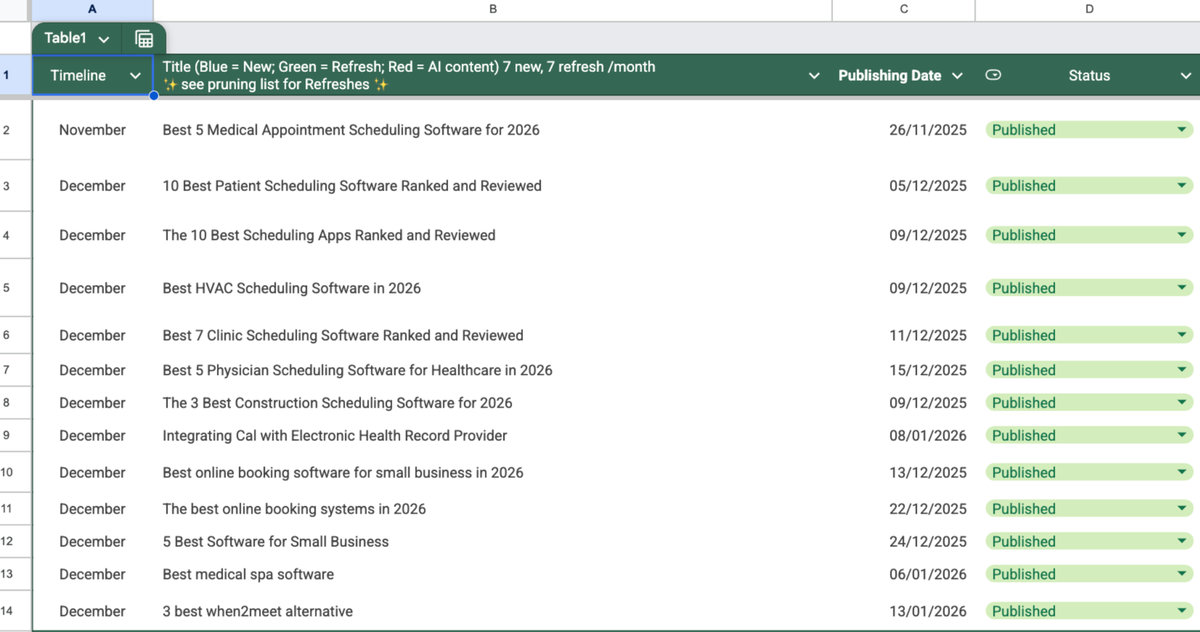
This is why we keep a content calendar with the title, URL, primary keyword, owner and publish date. Before we commission another article, we check what we've already published.
It's not complicated. It just stops the team from accidentally writing the same article five times.
More pages also means more pages to manage
Every page you publish needs to earn its place on the site.
It needs links from other relevant pages. It needs to fit into the site's structure. It needs to be maintained. And if it isn't doing anything for the business, eventually you're left with a large collection of URLs that nobody really needs.
For Cal.com, we pay particular attention to internal linking because the strongest pages on the site can pass authority to pages that matter commercially.
Sometimes the fix is very simple. If an article is performing well, give it a prominent internal link from another strong page. If a page matters to the business, don't leave it sitting three levels deep with no meaningful links pointing to it.
More content doesn't mean more chances to rank
This is probably the biggest misconception we've seen with AI-assisted publishing.
A thousand articles don't give you a thousand independent lottery tickets.
If most of those articles are targeting weak or overlapping topics, aren't internally linked properly and aren't good enough to attract links or mentions, you've mostly created a thousand more URLs to maintain.
Where we have landed on AI-assisted content
We use AI extensively in the production process now. Research, outlining, first drafts, restructuring, editing, there are plenty of places where it saves time.
But we don't let the volume of content determine the strategy.
Someone still needs to decide what gets published, what keyword it owns, how it fits with the rest of the site, where it should link, and whether the final piece is actually worth reading.
The content prune, and what it did for Cal.com
We deleted a large number of pages from the Cal.com site, and traffic to the remaining pages rose afterwards without us changing a word on any of them.
The rule we apply is narrow and easy to audit. A page goes if it has zero clicks, zero impressions, and is not indexed. Those three conditions together mean the page is doing nothing for you and is costing you crawl budget.
Running takes an afternoon. Open Google Search Console, go to the Pages report, and look at what is indexed versus what is excluded. If a site has a large volume of AI generated content, you can usually predict what you will find before you look: most of it never made it into the index.
The cause varies. Thin authority signals, too much published too fast, cannibalization across the set, a domain that has not earned the trust to support that volume. The remedy does not vary much.
The instinct to keep everything because deleting feels like destroying value is the wrong instinct here. Those pages are not neutral. They are taking crawl attention away from pages that could earn.
Parasite SEO, including the move we'd make with a $100 budget
If your own domain has little authority, publishing another article on it isn't always the fastest way to get visibility.
That's where third-party platforms can help. You're putting useful information about your product somewhere that already has an established audience, search presence or both.
Cal.com is an interesting example because the company has built enough authority that even its public booking pages can rank independently. Search for someone's name and their Cal.com booking page can sometimes appear on the first page.
You don't need a domain that is strong to use the same principle. You just need to find places where your product can be discussed naturally and where the page has a chance of being discovered.
What we'd do with $100
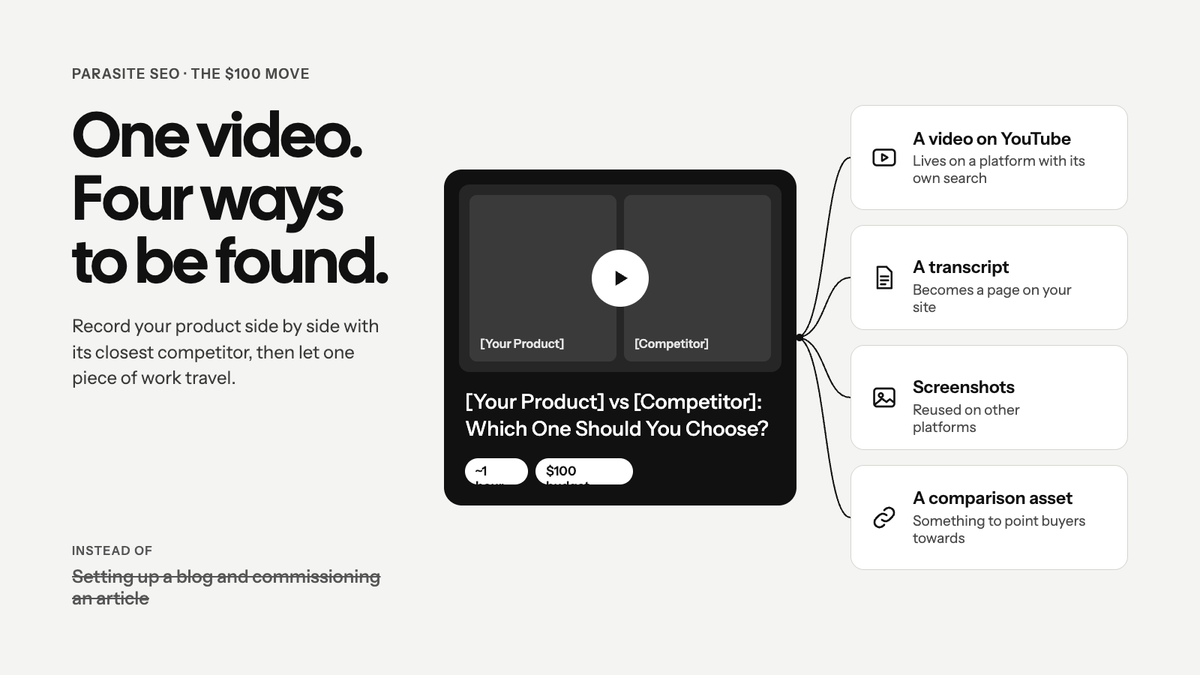
If you gave us $100 and a new SaaS company with almost no search presence, we wouldn't spend it setting up a blog and commissioning an article.
We'd record a video.
Open Loom or another screen recorder. Take your product and the closest competitor. Walk through the two products side by side. Show the differences. Explain who each one is for. Answer the questions a potential buyer would actually ask.
Then publish it as something like:
[Your Product] vs [Competitor]: Which One Should You Choose?
Now you have a video that can live on YouTube, a transcript that can become a page on your site, screenshots that can be reused elsewhere, and a piece of comparison content you can point people towards.
The whole thing can take an hour.
That's a much better use of a tiny budget than spending weeks building a publishing machine before you have anything worth publishing.
We use this approach with clients now because it gives one piece of work several ways to be discovered.
Track revenue per article, then stop trying to track everything
There are two things we care about when measuring SEO.
First, we want to know which pages are actually producing business. Second, we accept that we will never see the full impact of AI search in analytics.
Track the revenue you can see
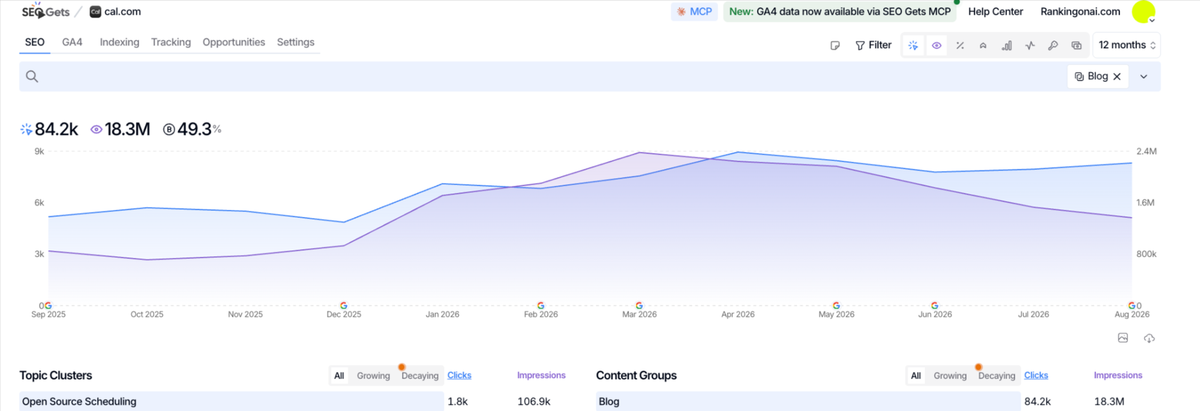
We spend a lot of time in clients' analytics looking at which pages are driving signups, demos, trials and purchases.
If one article generated 30 signups last month, or contributed $30,000 in revenue, that matters. It tells you something useful about where the content budget is working.
The setup isn't particularly exciting. Define the key events in GA4, make sure the tracking fires properly, and connect those events back to the pages that contributed to them.
The payoff is in what happens afterwards.
Instead of saying “organic generated 500 demos,” you can see which pages are actually contributing to those demos. That changes what you publish next and where you put the budget.
Those are the numbers we bring into client meetings: what happened last month, what generated revenue, and which pages contributed to it.
Accept what you can't see
AI search is harder to measure.
Someone can see Cal.com recommended in ChatGPT, close the window, and type cal.com into Google two days later. That visit will probably show up as branded search. Someone else might go directly to the site a week later. There may be no obvious connection between the eventual visit and the AI answer that introduced them to the company.
AI answers also don't always contain a link, and even when they do, the person may never click it.
So the analytics will always show only part of the picture.
That doesn't mean we ignore measurement. It means we don't wait for perfect attribution before making decisions.
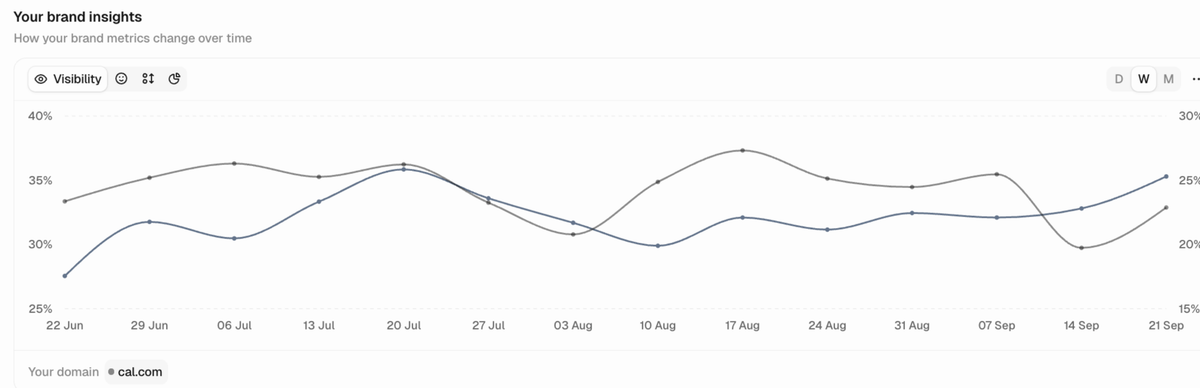
If the same prompts repeatedly recommend your product, your brand mentions are growing across relevant sources, and the pages you're investing in are generating revenue, you have enough information to keep going.
You don't need to know exactly which AI answer influenced every eventual customer.
Track what you can. Use the rest of the evidence to make decisions. Then get back to doing the work.
Who should own AI visibility inside the company
For a B2B company, keep it next to sales. It is lead generation, and it works dramatically better when the people writing the content can talk to the people taking the calls.
Where there is an existing SEO team, they will usually carry it, because they have the content and outreach capability already. Where there is not, it lands with general marketing. But the pattern we now see working best is a direct line into the sales team, for one reason: sales calls are the best keyword research available.
We can ask a sales team directly why a deal closed, what the prospect said they needed the product for, and what language they used to describe the problem. That is better input than any keyword tool, and it lets us move fast. If a feature question starts coming up on every call this month, we can have a page live about it inside a week, rather than discovering the trend in search data a quarter later.
It also changes what counts as a viable target. We can go extremely long tail, into terminology with almost no measurable search volume, because we are optimising for citation in an answer rather than for a volume threshold in a keyword tool.
There is a loss case that sales teams recognise immediately. A prospect is already in conversation with you, doing their own diligence, and they ask Claude or ChatGPT how you compare. If the model says a competitor is stronger, or says it has never heard of you, the deal is usually gone, and the rep never learns why. A lot of the demand we see now comes from teams who simply want to be present and accurately described at that moment.

Starting from zero: the three things we would do first
If you have no content and no rankings, these three come before anything else, in this order.
- Fix the technical baseline. Make sure the site is crawlable, that any client side rendering is resolved so crawlers see real content, that a sitemap exists and is submitted, and that Search Console and Google Analytics are connected. None of this is glamorous and all of it is a prerequisite.
- Create an outside presence. One product walkthrough and one comparison video, following the approach above. This is the highest return per hour available to a small team right now.
- Be consistent, and give it three months. Publish deliberately, keep the calendar clean, and let it compound. Specifically, do not fill that waiting period by generating a thousand pages, because that will undo the first two steps.
In year one, chase your achievable wins rather than the most ambitious content you can imagine. A piece that takes six weeks to produce and six months to rank is very hard to defend internally when nothing else is working yet. Get the first results, prove the channel, then invest in the harder work.
This channel is close to winner take all
Unlike social, AI recommendation is close to zero sum, and that is what makes it worth competing for.
Five brands can all run successful video accounts, reaching different audiences, barely competing. AI recommendation does not work that way. Someone asks for the best scheduling tool once. They read one answer. They do not run the query fifty times and compare. Whoever is named gets the consideration, and everybody else gets nothing from that query.
Compare the trust economics. Earning someone's trust through a YouTube channel might take seven hours of watch time spread over months. A single AI answer confers something close to the same confidence in thirty seconds, because the model is treated as a neutral arbiter rather than a marketer.
The painful version of this shows up in our inbound constantly. A company comes to us because a competitor with a visibly worse product is being recommended and they are not. The competitor's SEO is better, that is the whole explanation, and it is a hard thing to accept when you have spent years on the product. Being the best product and being known to be the best product are two different jobs, run by two different teams.
It is worth saying that the usual objection, that Cal.com was already well known, is partly fair and does not explain the result. Cal.com had strong adoption among developers and founders well before we started. It was considerably less known to the VPs and directors who sit in the early majority, and that is exactly the group this work reached. Plenty of companies have an excellent product, years of goodwill and open source credibility, and no AI visibility at all.
What To look for when hiring for SEO
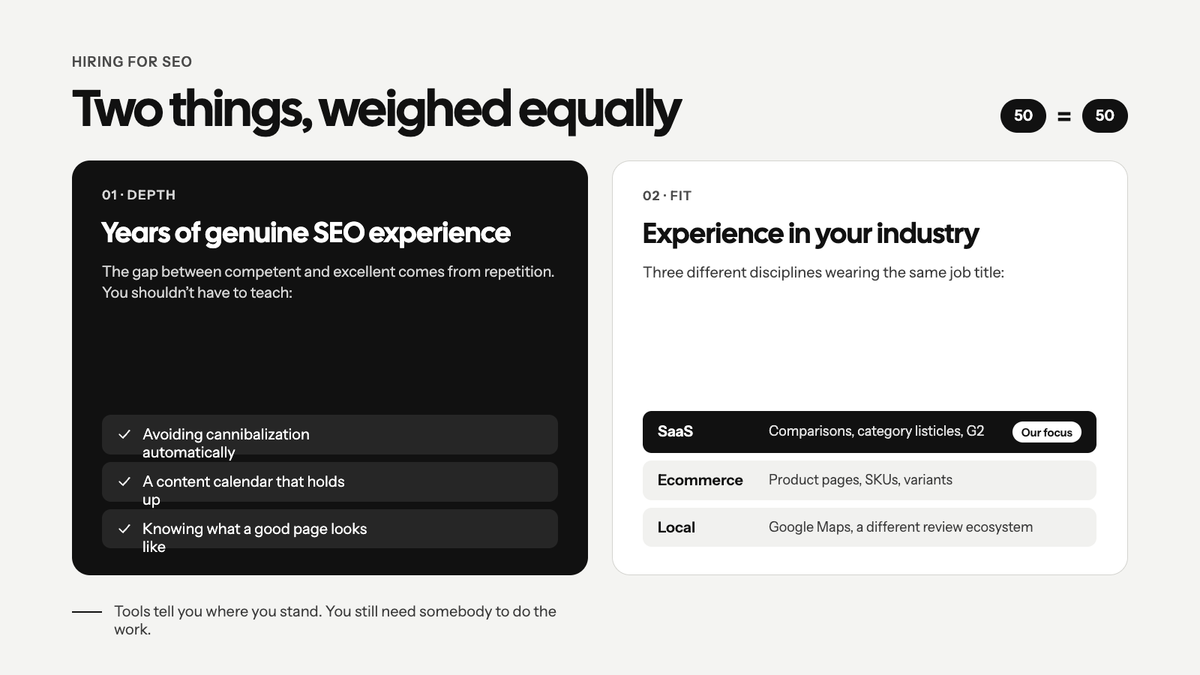
Two things, and we weigh them about equally.
Years of genuine SEO experience:
You can get surprisingly far on the basics, but the difference between competent and excellent is large and it comes from repetition. Someone who has done this for years avoids cannibalization automatically, builds a content calendar that holds up, and knows what a good page looks like without being told. You should not have to teach any of that.
Experience in your industry:
SaaS, ecommerce and local business are three different disciplines wearing the same job title. Ecommerce means product pages, SKUs and variants. A local business means Google Maps and an entirely different review ecosystem. SaaS means comparison content, category listicles and G2. Someone excellent at one is not automatically useful at another.
We only take SaaS clients for exactly this reason, and we say no to work outside it. When a plastic surgeon asked us to take on their practice recently, the honest answer was that we could do something, and that somebody who works in medical practices every day would do it better. We would rather do one thing properly than be adequate at four.
On tooling, we use Peec for AI visibility tracking. It will tell you where you stand and what to act on, which is a reasonable place for a team to start. You still need somebody to do the work.
Frequently asked questions
How can I see which sources an AI assistant is using?
In ChatGPT, open the More actions menu on an answer and select View sources. This shows the pages the answer is drawing from and gives you a starting point for understanding why certain brands are appearing in the recommendation.
Does getting mentioned on other websites really matter for AI search?
Yes. AI assistants pull information from across the web, so your own website is only part of the picture. Comparison pages, reviews, directories, industry publications, YouTube videos and other third-party content can all contribute to how a company is represented.
Should I focus on informational content for AI search?
For commercial visibility, we’ve had better results focusing on searches where someone is already comparing products or looking for a recommendation. That includes comparison pages, alternatives and specific “best” searches tied to an industry or use case.
Can AI-assisted content work for SEO and AEO?
Yes. We use AI throughout the content process, including research, outlining, drafting and editing. The important work happens around that process: deciding what deserves a page, avoiding overlapping topics, linking content properly and having someone review the finished article.
How should I measure AI search?
Track the things you already care about: traffic, signups, demos and revenue. At the same time, keep an eye on how often your brand appears in the searches that matter to you and which sources are appearing behind those answers. AI attribution will never capture the full journey, so the two sets of data need to be looked at together.
Full interview transcript
Interview with Ryan (go-to-market, Cal.com) and Tanya van Gastel (founder, Rankingonai.com). Timestamps link to that moment in the video.
0:00 We can say with certainty that that we have coming in on our sales motion, is coming from or AI SEO or AEO. that has essentially tripled since we had originally started working together, It's actually a to say number one in AI visibility. It feels a bit like a black box, but really it's not. Today I'm sitting down with Tanya to talk about something that's quietly becoming one of the biggest shifts in how companies get discovered, AI visibility. Over the last year we've been pretty obsessive about understanding how brands show up inside of chat GPT, Claude, Perplexity and the rest of the emerging answer layer. Recently CAL was ranked number one for AI visibility in our category and ahead of many companies that are significantly larger than us. So I wanted to sit down with Tanya who's been deep in the work with us to unpack what actually drove that, what we learned and what companies should be doing and thinking about as discovery moves from traditional search to AI. Welcome Tanya. Hey Ryan, thanks so much for having me on. Honestly, super happy that we're having this conversation. I know it kind of came about because of this tweet that kind of went viral last week on X about literally how Cal is doing so well in ChatGPT, getting recommended everywhere.
1:33 And I know of course that's a lot of the work that we do as well. So super fun to share a little bit more about how we've been doing that. I would love to start with first when we say number one in AI visibility, what does that actually mean? Yeah, it's actually a horrible term to use to say number one in AI visibility. Of course, what does it mean to be number one in AI visibility? There are a lot of different clusters and prompts that you want to be ranking for. That's one thing in general, AI visibility tracking, I always say it's a bit of a nightmare. Whenever I search for something, I get very different results than when someone else searches for something. There's different tiers when it comes to someone who's on a paid account, someone's on a free account and even between ChatGPT, Claude, Perplexity, Google AI overview, there's a lot of different ways that the engines are actually picking things up. Now what does it mean to actually be number one in AI visibility? Let me show you what that looks like for one specific prompt where you guys here are showing up as number one. Let's say you ask ChatGPT, what is the best free calendar scheduling tool? You'll see that it gives you a bunch of recommendations.
2:52 It's telling you cal.com, Google Calendar, Calendly, and the third place. But at the same time, if you ask for it again, I just ran another prompt, it could just give you completely different answers. Here it's saying cal.com, zcal, then Google Calendar, and then Calendly. How are you going to go and say, "Cal.com is always number one"? It's number one across these two different prompts right now. Let's say you guys are zcal or another competitor, you're not consistently in that top three. That's really what we're aiming for, consistency in the top answers, in the top recommendations for your specific strength or the query that you want to be ranking for. A lot of people will ask, "How do we actually get into AI? How do we actually get recommended there?" It feels a bit like a black box, but really it's not. ChatGPT will tell you very directly where it's sourcing all of that information from. It's not really getting anything out of thin air. It's sourcing it from its index, which is the internet, and specifically the search graph. I'll jump in there. A lot of people might say, "No one really knows how AI SEO works," or "AEO works," or they might tell you that, "Oh, it's just SEO, just rebranded." What would you say to that?
4:15 Yeah. I do think that AI visibility is one of the best things that's ever happened to SEO. I absolutely have an SEO background. There's a huge amount of overlap. What is SEO really? It stands for search engine optimization, but more and more, we add in AI to that specific layer. We'll call it AEO. We'll call it whatever we want. But SEO has always been something that changes, and SEO always is about influencing information flow. It's about showing up where people search for things and making sure that information is accurate, and also that you are properly represented. When it comes to that, I think it's very, very similar. I don't think SEO is dead or anything like that. I do think it makes for a kick-ass headline, "Please run with it. Do whatever you want." But at the end of the day, a lot of the same principles that hold in SEO are the same principles that hold in AEO. Create really great content and get into really great content. Spread your name far and wide into places that are relevant for your audience. That's literally what I want to show you now, which is that if you want to figure out where actually chat GPT is getting that information, it's not a black box.
5:37 You can click on the little More Actions tab and then click on View Sources. It's literally going to tell you a bunch of the sources that it's gotten that information from. Even here, it will tell you where it gets that information from. It's saying Cal.com, this individual plan, Free Forever, etc. It's getting that from here, the Cal.com pricing page, etc. Here, it's telling you the 50 different sources that it went to go and check to go and establish that information. Here, for example, ZenCal is not mentioned. ZenCal is cited in the sources. ZenCal is, for example, used to say Cal.com is doing really well. They do that through a bunch of bottom-of-funnel information. Very funny, sometimes you'll see these sources that absolutely have nothing to do with it. I just ran this prompt earlier and I saw that there was this listicle about the best calendar scheduling software for Tarot readers. It makes absolutely no sense. But that is sometimes how chatGPT works. It will go really long-tail in terms of showing recommendations and citing those sources.
6:58 That's really where you want your content to show up and where you want your brand to show up. Interesting. I want to share a little bit for the audience just what that number one in ranking does for Cal. As I had to go to market, I'm overseeing where every meeting comes in, where every dollar comes in from. We can say with certainty that one out of three meetings that we have coming in on our sales motion, not our PLG motion, is coming from AI visibility or AI SEO or AEO. Due to the work that we're doing here that has essentially tripled since we had originally started working together, which is the beginning of this year or just about. I want to go through that tweet a little bit and I want you to point out the things that Mal here wrote. What is he getting right? What is he not getting as right in getting that number one of visibility and everything there? Because it didn't exist before the same way. A lot of people I think in the comments are also sharing, "Oh, that's just what happens when you have a great product." They've been doing it for years. Obviously, it's great to have a great product, but there are plenty of people with great products that don't have this visibility.
8:19 So I want to kind of touch on those pieces. A hundred percent. So everybody who has built anything will know that this whole idea of you build it and then they come, that's not a thing. Literally, 2026 is the year of vibe coding. You can create the best product with the most amazing features. How will someone know about it? If they cannot find your product, then of course they're not able to sign up and convert into anything. And so I always tell people like, "What is your actual marketing plan? How are you going to make your first dollar from your clients? You've built the product. Now, how are they going to find you?" And so increasingly for AI visibility, that answer is through content and through those placements that we just discussed. So going over Mal's tweets, I spent some time reverse engineering how Kyle went from unknown to the number one chat GPT recommended scheduling tool. They have 47 comparison blog posts and even more general posts. Okay, I love this. This is really good. I'm very happy that he picked up on that. I'll go over them one by one and also add in some things that he may have missed that I think will be super helpful for people to know too. So compare some blog posts. Why does this matter?
9:38 When we think about content, we think about content in terms of a funnel. So you have top of funnel content, super informational. That's maybe just someone searching for what is a calendar scheduling tool. Then you have like middle funnel and then you have bottom of funnel content. Bottom of funnel content, literally that's where conversions happen. That's where someone is ready to purchase. They are comparing all the different types of platforms that they could be useful for you. And they're doing a lot of research in the process here. So all the main solution aware. Exactly. Ready to make a choice that reduces the pain. That's exactly. That's exactly what it is. That's a really great way of putting it actually. So they're looking at like Cal versus Savvy Cal or Cal versus something else. And so it's really important that we show up there and that we are able to talk about what the actual differences are in a way that is super honest and that helps the user to really make that decision. So comparison blog posts, listicles, the best of blog posts. And I would say that that is something that he missed a bit. Is we do a lot of listicle content where we speak very honestly about what are the features that Cal is really, really great at and maybe not so great at.
10:59 And where basically do we want to position Cal? So let's say that we look for like B2B more than B2C. You will go and create what is the best, you know, B2B calendar scheduling app for this specific industry. And that's the kind of like best of blog posts that I also highly recommend people to share in their AEO and SEO strategies. For the general posts, honestly, I'm not a fan anymore of informational content almost at all. Product lead can be really, really great. I would say typically when you're looking at just informational and not necessarily product lead, just informational. Nobody is going to really search for those type of content anymore. People are going to ask chat GPT. They're going to ask Google. So they're going to ask Claude. So even if you say like what is a calendar scheduling tool, you're not necessarily looking to buy. You look it up and even if you show up here, it doesn't really matter. Your answer is just going to be immediately answered by Google A.I. overview and then that's it. So in the past, before A.I. overviews, honestly, a year ago, a year ago, you would search for that and then maybe you would, you know, show up on Calendly and you'll understand, they'll explain to you what that actually means.
12:24 What is a calendar scheduling tool? And then maybe you would convert there, but that just doesn't happen anymore. So these very informational posts is something that we completely stay away from now. His second thing, every single one is structured as a direct answer to the exact question. People ask A.I. chat bots. I think it's really great that he picked up on that. That's really important. There is something to FAQ style content that works quite well, especially in the past that is becoming less and less so. So right now it's actually, it used to be very, very important to, you know, make sure that you have added all of your schema, et cetera. That would make a huge amount of difference and that's kind of becoming less and less. What's becoming more and more important though is beside your own blog post is third party platform recommendations. So we saw earlier in the year, actually maybe earlier in the year and also end of last year, that Reddit was by far the number one most recommended, most cited platform across all of chat GPT. Basically, chat GPT and Reddit created a partnership through which OpenAI was able to scrape all of the data super, super easily, plug directly in that. And then that, of course, as is usually the case, led to a lot of abuse and now they've kind of half decimated really the content coming in through Reddit and coming in through recommendations.
13:56 And this is a super typical, extremely normal thing within SEO and this is why AEO is so similar to SEO. It's a bit of a cat and mouse game in certain regards. There are always a lot of short term tactics that people can use, but really the long term strategy always is to create great, helpful content that people love. This is something that will, that's forever, right? But things like... That is peer reviewed or back linked and third parties or... And peer reviewed has good back links that typically is like just very, very high quality that is like actually really helpful, right? So things like in-depth reviews, things like in-depth comparisons, making sure that your content really like adds value and doing multiple checks on stuff like that. Extremely gives you extreme longevity. Whereas things like, you know, schema markup, Reddit, all of that work extremely well and can be amazing in the short term to medium term. And honestly, I highly recommend that people also build on that because that can give you a huge leg up. But in the long term with SEO, we look at great, helpful content. How does someone... Sorry. No, no worries. I just like add that within marketing, we see a lot of that, right?
15:16 Like we always see trends that we need to jump on so that we can take us to the next level and continue growing. And typically I would say like the super strong, super wonderful, super long term content, that's not going to be something for your SEO journey. Typically in the first year. In the first year, you're looking at what are your easy wins? What are your 10 demos booked per day that you can go and get and that you can go and achieve? And how can you get your first wins so that you can continue to grow and really continue investing in that strategy long term? So especially for, you know, people who are... Startups, whether they fundraise, they've done whatever. If you don't have any content yet on your website, focus on starting to get that organic traffic and you're going to do that, not through the most super, super high level content. Just because that's going to really typically drag you back is also very hard to justify internally while you've been working on the same piece of content for like a month and a half. And then you won't see results for another six months. So I always say focus on your first wins. There are plenty of them. One of the reasons this has been fun is because not only you, your personal friend that I get to work with on this, but also that if we say something like we are prioritizing meetings or signups, a lot of agencies in general will let you know, this is something that takes six months plus to really see the value of.
16:54 And you might not ever get there. I think you've certainly delivered on that in terms of what our meetings look like in terms of what our signups look like. And we've given you a high bar from the start. This is where we would like to be. Would love to understand what you're doing differently when it comes to some of that authority that you're talking about right now about knowing where to place pieces where you are placing them. I think that's something that's very interesting for people to hear that how you're thinking about YouTube or Reddit or not using these things that people put like put a lot of attention in and where might other folks that are doing exactly what we're doing wasting money on agencies or people that, you know, strategies that just don't work. Yeah. Honestly, the three questions, revenue platform and waste of revenue, bottom line of everything. I think when it comes to, you know, this perspective and I think we do this quite differently. We really focus on your key analytics like I'm in the Google Analytics connected to, you know, my cloud MCP digging into client data every single day to figure out what is actually moving the key event. And it's something I literally posted about is that I love to point at an article and say this article brought in 30K US dollars last month.
18:21 Right. That's an amazing thing to be able to say from just one piece of content. And a lot of the time we can say that about our content because we focus on analytics. Right. So what is good analytics is being able to say this post gave me 30 signups, 30 purchases, 30 trials, 30 whatever. It's literally just allocating key events on two things like GA4 and it's typically very, very, very difficult to do on certain websites. It's a lot easier now with vibe coding with being able to plug in something like a Google Tag Manager much easier with like a cloud code MCP into, you know, a cloud code created website. Focus on your 8020 honestly, but being able to say all of the all of the signups or all of the demos booked. From the last two months have come through only this type of content is extremely powerful because then you know you can just go and double down on that type of content or you can go and figure out why something is not working. Because when you as you know, you're head of marketing or GTM or whatever you go and say we have 500 demos booked, but I don't know why. I know it's because of organic. You don't know through which organic thing that can get really tricky because you don't have a clear path for growth.
19:42 Right. Like how are you going to continue investing the next part of your budget into what will hopefully be the next big driver of sales. So I always say like get those analytics sorted. It's the most boring thing. You get it done one time. It's out of the way and we can all look at these really great metrics and I like to start all of my meetings with them. This is what happened last month. This is how many you know how many how much revenue we brought in. This is how much we were actually able to get in terms of demos booked frankly because as an agency that makes my life really easy as as like as we're able to show that ROI. It's a no brainer for our clients to stay with us in the long term. It's this is the the monthly retainer and this is a revenue bring in. I want that conversation to be super obvious and super clear. Stick with us forever. And that's that's really kind of the way that we're going as well. Secondly so track track track early and often. Jack early and often. And I'll add to that that I I do all of this because I used to be a founder of a photography sauce. We worked with companies like Google Deloitte stuff like that. We did B2B AI headshots.
21:01 We were able to sell that business last year but I was the only SEO and marketing person and you were a team of three people. So literally everything was about oh how can I spend as little time as possible and still get significant kind of demo booked. You to be pipeline etc. And that was really the only way to do that is by being super ruthless about where you spend your time and where you can double down on the type of content that actually converts. Revenue. The second thing was about platforms I think so YouTube Reddit. There's a couple and they'll go through different shifts and honestly some of them will be much easier and much more adaptable to like your specific marketing than another one. That it honestly I think it was an amazing platform. I'm I'm a huge Redditor. It's like the thing that I like will open up first thing in in the morning and I love it. It's right. So my news frankly it's become very different right partially because it's been rewarded so heavily by open AI but then also been punished. So I have lead by open AI. So a lot of the time now that it is extremely strict in terms of comments taking them down moderation.
22:24 I believe you can't post two comments in a row or something you need to like wait seven minutes. There's a lot of different rules about all of this. It's frankly not really where I would recommend people to spend their time because unless you really know that something like your Reddit thread specifically is working really well for your industry right now that's going to be short lived. That's honestly going to last like two three weeks. You cannot necessarily comment on it. It might be archived. It might not work. It might just take you a lot of time to figure out how to do that. There are platforms that help you with this but honestly they don't work as well and they tend to not be where I would spend my money if I was a marketing manager. I would spend my money on YouTube right now hugely. So good thing and bad thing about YouTube. When it comes to YouTube there is a huge amount of AI visibility correlation and this has been proven in studies time and time again. Ahrefs came out with a study where they show that I believe there's a 70 percent correlation between how often you are ranked and recommended in AI and how often you are represented in YouTube. In human terms this means that if there are videos about you on YouTube you are much more likely to be recommended and this makes a lot of sense right because think about it from opening eyes point of view.
23:49 They're currently in the business that Google has been in for the past decade which is surfacing helpful information giving a helpful answer and doing that by having helpful sources. So if in the past people were using Reddit to go and surface a bunch of things and then people started abusing that and that's text what is one level more difficult to execute and falsify then text is video. So what we see now is that YouTube is working extremely extremely well and so as part of what we're doing now is we have partnerships with youtubers where we will go in and ask them to do a collaboration. We'll do a type of like influencer partnership and really focus on SEO and AI visibility optimizing that piece of content. I sent you a chat that is a link to an X post that is a bit of a warning towards people on what happens when you just do what everyone thinks is the, you know, chat ramming option in a you know SEO which is the first thought is why can't I just put a hundred articles up a day with a bunch of agents.
25:08 You know doing this you see a bunch of articles for the last year two years saying oh how I got you know my a SEO agent to do ten thousand dollars of what an agency would typically do overnight. But when in reality you and I both know that that has dire consequences for cannibalization of not having long tail success I think you can add some color to this and kind of in that myth for folks or maybe it's true I think people would love to hear a little bit about that. AI generated content is spectrum. People think of it as a binary thing they switch on and off it's not there's a huge amount of difference between good I generated content that I generated content and horrible I generate content right so. Let's work in terms of like the lowest level of a generated content and work our way up to what is actually better and better. The lowest level is a generating hundred pieces of content a day and then just auto posting them with absolutely no context context about what your company does. Just maybe the link the landing page no internal linking towards each other no information hierarchy no EAT which stands for basically.
26:40 Authority indicators so that people know it's a real person EAT includes things like a name a bio of the author. Sometimes even like social media profiles all of these indicators add up and get. indexed in terms of how Google perceives a piece of content and so this is super super well established once you just go and autopilot your hundred pieces of content every single day. You can post it it's not even going to get indexed actually what's going to happen is Google is going to say you are creating spammy content and this is a very well established. piece of truth that Google hugely penalizes once it sees that your website is full of spam. So you go and create your thousands of pages Google says no I don't think your website has any value because I don't think that you're really doing anything. How do they know that. They know that because they look very very heavily at these authority indicators right so what is a good piece of content right this this is like the crux of that specific question what is a good piece of content. And what is a bad piece of content and so all of this it kind of like changes over time. What is a good piece of content a good piece of content is much harder to determine than like a bad piece of content, so let me tell you first what you should not do.
28:10 Right, you should not post a ton of content that is similar to each other that is targeting a specific same piece of keyword right so let's say that. This keyword best best. Best calendar scheduling tool for met spas. Best calendar scheduling tool for met spas if we create five pieces of content that are all about five best calendar scheduling tool for met spas what if they all compete for the same keyword. That means that maybe one piece of content will be on the second page another piece of content will be on the third page etc that doesn't work at all right so what's much more powerful is if you only have one of those and then you provide a lot of internal linking to each other. Internal linking. Is related to the concept and these are a bunch of like very SEO concepts but bear with me because ChatGPT does take a lot from the Google search graph even going as far as using SERP API for a really long time to basically take exactly what is ranking on the first and second page of Google to feed that into ChatGPT. URL juice basically means the strength of a certain URL on a website so for Cal dot com the cal dot com landing page is the most important highest URL.
29:42 High as URL juice page on the entire website what is the second most important it's probably going to be something like the pricing page the third most important will probably be something like the slot cal dot com slash AI page. Why are these the most important pages they're the most important pages because a lot of other pages link to those pages. And so your internal linking is really really important that's why it's important that's why SEO is always say to add things to the navigation bar to add links to the footer. Your most powerful articles that are doing really well one of the best easy ways to boost them is to add them into your footer because that's really what's going to happen that's really what's going to boost the URL juice. Of that page because now you're going to have internal link to your best ranking blog post on every page of your website is a very easy thing to do when you are creating thousands of pieces of content you are not taking any of that into account. So that's the first thing you need to be really thoughtful and strategic about your content second thing is avoid cannibalization every piece of content needs to have one specific keyword one specific main keyword that it ranks for. And thirdly you really want to make sure that you are finding the right keywords to target if you again are looking at targeting keywords that are informational right thinking back to our funnel that are informational nobody's going to convert on those you really want to be targeting things that are super bottom of funnel and you only want to target one piece of content at a time.
31:20 What is cannibalization and how do people avoid it. You there's a couple of different ways to avoid it frankly in like very practical terms my my favorite type of terms is I would say go and create an Excel a Google sheet content calendar. Put in a row put in like columns with your title your slug your main keyword that you want to rank for and the author like who is creating that piece of content or who is responsible for it and then also when that piece goes live this whole page will help to set your strategy will help to set your strategy. So it will help to set your strategy in terms of which keyword is targeting which page cannibalization means that you have multiple pieces of content trying to rank for the same thing. You want to avoid that at all costs because it dilutes the power of that piece to perform and to rank really well and that goes basically the same that goes way stronger for Google than it does for chat GPT but in general is something that you've seen really holds true is that you want to have less pages rather than more. And cannibalization is just one way to look at it so why do you want to have less pages on your website rather than more why is it better to have five really good pieces of content rather than a thousands because people may think oh if I have thousands it's like a lottery ticket and then I just have a thousand lottery tickets.
32:57 They think of it like short form content just think of it like a different content exactly it's not like that at all it's much more like writing a best seller or. I don't even know it's not really a very good comparison well if you if you were an author that got a hundred books out and you're known as someone who just makes a book every week the chance of that. 50th or 100th book of someone picking that up off the shelves might be a little low compared to someone who writes a book every 10 years and tells you about what they learned for the last 10 years is that something like is that a good metaphor for you talk. It's a lot better than my mother. Let me just say that it's much more meritocratic than assuming that things are a lottery ticket. It's like on tech talker X for instance you don't really get penalized for the number of for the volume but here you would is that you do so you do because of the concept of crawl budget. So crawl budget essentially is a concept where Google only has a hundred crawl budget to allocate to every single website. So if one website has a million pages and we have clients who have websites that have millions of pages not every single page is going to get the same type of crawling because Google allocates a limited number of budgets to you.
34:29 Google bot is not able to go and crawl into all of your millions of pages because it also assumes that if you have this many pages a lot of them are probably not as important as other ones. Fair and it generally will decide that through the help of things like internal linking again seeing how many pages you have and many more things. The number of pages you have is one of the most important things also for your crawl budget so it's why typically when it comes to user generated content pages you want to be very careful that these are not spammy on different types of websites. And it's something that we try to be very very careful about so similarly if you have thousands of pieces of content Google doesn't respect every piece of your content as much as it does another one. We would rather do a content prune and so let's talk about outrank right because I. Yeah I mean I wanted to ask you you know delete a lot of our posts want you to help explain why a little bit. We call it a content prune typically when a site has a lot of a generated content you can go and see in your Google search console just Google Google search console it's going to give you the link.
35:47 And you can see which of these are actually getting indexed index means that they show up at all in Google that Google is aware that they exist if you have a lot of. A lot of content that is a generated can almost guarantee you that they're not really going to get indexed and that's a huge problem it could be because of EEAT It could be that you just have too much content that you posted it too fast that you your cadence is completely off that is all being cannibalized that Google just says no. That your domain rating is too low it could be a lot of different things right so the cause will typically vary. And so what we do then is we do a content prune which is where we say all the content that is that has zero clicks zero impressions and is not indexed deleted. Because we don't want that on your website it's not helping you at all it's not driving anything so why is it there it's just taking away crawl budget from one. Actually helpful page to a page that is not really helping you with anything and so that content room typically which we also executed on the cal.com website. Took away a bunch of pages and it hugely increased traffic afterwards to all your existing content without even changing the existing content and that's really the power of crawl budget and understanding that concept being careful thoughtful and strategic with your specific content.
37:25 That's a that's a great answer. Do you care to explain a little bit about what parasite SEO is. Yeah perfect. I think parasite SEO is one of the it's one of the coolest can kind of like border and like gray hat almost black hat in some ways tactics within SEO. It's also kind of like why it has that name parasite SEO is basically when you use the domain rating so the trust score of one website to boost your own goals. Let's put it that way. So parasite SEO shows up very very powerfully right now in websites like medium where a lot of bloggers post on medium affiliate bloggers post on medium doing really really well reviewing all kinds of staff tools AI tools etc. And then they put their affiliate link somebody sees that piece of content through Google they click on that link they convert them parasite SEO done really well. Why is that parasite SEO is parasite SEO because the blogger is using the medium domain rating to go and convert on their blog. And the domain rating basically is a concept of how strong is your website how highly does Google trust your website and that's related to backlinking.
38:47 So backlinking is basically to link that you get from one website to your website and every single one that you get ideally if their trust rating is really high then your trust rating will also go up. But so why is this relevant for Cal.com? So Cal.com has a really powerful domain rating extremely powerful it's like a top 5% in the world I think maybe even like 3% in the world websites in terms of domain rating and that's huge. It means that basically anytime that anybody makes a Cal.com profile because they are public and they are indexed you will be able to find that person and find their booking link. So let's say that I searched for your name I searched for Ryan was. I'm pretty sure that on the first page of Google it's going to be your booking link so here we go Ryan was okay I look and there we go here's the Ryan was Cal.com booking link. And so similarly for different key terms that you could search you can go and create an account on a website that's very strong to you are like Cal.com put in your key term and then you would likely rank very very highly for that keywords using the Cal.com domain rating which again this is what we call parasite SEO.
40:16 I think a lot of people just in our network utilize that without the parasitic part you know just services and whatnot but yeah it's I didn't know that word and now today I do. I knew people were doing it and I didn't know that I didn't name. Yeah it's not necessarily bad at all it's something that's very very common practice. It's also something that like has that name specifically because it has been abused a lot within SEO as the industry but it's not something that is bad in any way normal. What I would love to do is kind of maybe kind of go into a few more questions and then maybe finish up on that tweet of comments or funny things that people say. I think some we have here is so you know I'm the head of go to market here at Cal less than a year ago we didn't have go to market team. I do oversee the marketing side the brand side and the actual go to market side of the revenue money printing side of things in your opinion with everyone you work with who owns AI visibility. Is that a GTM thing is that a brand visibility thing do you even care. I really care I would say that like in if there is an SEO team is typically the SEO team that will carry it.
41:47 Generally because they have the content and like outreach capabilities if it's not an SEO team it will generally be a more general marketing team. But I will add that more and more we're seeing this with working directly with GTM and also sales teams and so that's super super helpful for us because it allows us to ask sales teams very directly like we do all the time. Why are people converting on Cal.com when a client comes in what is it that they tell you that. They want to use your product for because we can use those things and we can really create so much content around them that is way way way more powerful than being able to just kind of grasp in the dark or even like look at the data of what we see with SEO search terms. Especially would you say that for someone getting to their first million in ARR or someone like us that was going from five million to ten million when we brought you on and now one in three meetings are attributed to this. Or going from ten million to one hundred do you think that that should change teams or the where AI visibility should be placed. I think if you're a B2B it should be a sales related item because that's really going to funnel directly into it right it's ultimately what it is it's lead generation for your sales team.
43:16 And so working together very closely with that sales team is one of the most powerful things that we can do because we can talk to them so directly about what is happening in the sales calls. It may happen that you know something shifts in a it's very relevant to your product and suddenly all of your clients are asking about this one specific feature whether you have it or you don't have it. That's not well established in the content around it and we have a really good open channel in terms of communications you can immediately push out a piece of content about that and get you to double down triple down on what is actually. What is actually driving all of your customers right now so in my opinion I love to work with sales teams. We are very B2B driven as well typically if it's not going to be very B2B driven if there are no sales teams even of course it's going to lie within a marketing team. But I find with sales teams it's a really powerful thing to be able to talk directly to your customers to understand the specific terminology that they use as well. We can create the content around it we can go very specific very long tail and even if there's very little search volume around it that's actually not an issue because we are hoping to get picked up in chat GPT much more than we are in Google AI overview.
44:38 Another thing for sales teams that we often hear that I hear a lot is that when they're not represented when the product is not represented in chat GPT or Google that's where they lose the sale. So even if the client is in that vetting process and they've started the conversation with you and to other to other potential platforms or solutions if chat GPT or cloud in the end does not say actually they are much better. Or even if they say I've never heard of this platform the solution that you're talking about you're typically going to lose that sale. So that's really something where we're seeing a lot of demand from teams looking to just show up and be accurately represented in AI and so I for that love to work with sales teams on it. Yeah that that strategy going from maybe 10 to 100 million or just getting to your first million is very different. I think the first million is a lot like how we even initially started setting the groundwork taking all of the last year's sales calls finding the real reasons why people have come to us and then finding the gap in terms of what our words online said. And the real reasons people were coming for self hosting at a certain level or open source when we were open source or certain API accessibility things that are Cal only specific.
46:08 I think that was a really great thing that you're able to you and your team are able to create a database that then you wrap your skill set around in terms of tonality and making quality pieces that Google rank as high as possible. For quality mixing in I think at least 50 percent human in the loop writing correct. Yeah typically way more. We've gone on a bit of a look on a curve here where we now have a mix we still focus on the high quality human within content. We're also adding more and more AI assisted type content and so that's really where we're exploring that spectrum of what is a generated content. What is really high quality generated content that is thoughtful strategic has really good oversight is not cannibalizing is very strategically put out and still indexes and performs really well. For teams that are far more teams that are getting I think there's only about point zero four percent of all businesses are one in four hundred or something that get to ten million there are far more people trying to get to the first million. Yeah. Let's say they don't have like a hundred bucks and they can afford like a chat to be team and Claude you know subscription.
47:30 What's an easy win for them if they are starting from zero and they want to be ranked in the top five for their industry. Yeah if you have a hundred bucks I wouldn't even tell you to go and create you know like you want to have your CMS use something like sanity something like payload great. But I wouldn't even tell you to go and create that piece of content I would say go parasite SEO create a YouTube video yourself go on supercut go on loom create a video of just you going through your product comparing it to your competitor and call it your product versus your competitor which one is the best. That's going to perform way way way better than you spending a lot of time to you know create your CMS do this do that of course you want to do that in time. But if there are three things that I would say do first of course create your website make sure that it is technically good that there is you know any kind of like server site rendering is fixed that your website is actually crawlable connected to GSC connected to GA Google Analytics and Google Search Console. Submitted to submitted to Google Search Console so you can actually get indexed create your site map your basic super basic technical things second thing is going create that YouTube profile that's parasite as soon as well that will perform really really well.
48:59 Even if you don't get that many views you can still really get picked up in chat GPT and then when you do start to create content you can make a piece of content that is just a transcript of everything that you said add in your YouTube video take some screenshots from that piece of video and it's going to perform really well and that's something that we really like to do for our clients now to. Just because it's such a powerful thing to do to go and create those YouTube pieces of content thirdly and also you can do that with LinkedIn by the way because LinkedIn is also more and more getting picked up. But thirdly be consistent and take time because SEO is something that does take time and AI visibility also does take time so start doing your key actions and then you wait three months and in those days you can do that. So three months I beg you do not go and generate thousands of pieces of content because you're going to undo all of the work that you've done before so do the baseline work and wait. That's amazing. One thing I wanted to go back to was being in go to market you know for the last eight ten years in some capacity I've seen as a seller. How leads just changed over time and in short how things went from an outbound pushing strategy to an inbound like pulling strategy and just to wear trust in the market when so that could mean.
50:33 That a lot of the trust that was in outbound messaging in ads being put out there decimated the noises place in any executives life is their email inbox. Why it's why people resort to doing deals in the DMS or just organic social or even this in an enterprise deal B2B deal people are doing their own research and going to chat first or cloud first and they're. Coming to their own conclusions about what the best tool is for them. Now a lot of those things like I know we touched on tracking but a lot of those things are not as trackable we know for a shadow of a doubt that without a shadow of a doubt that you know yes one in three meetings might be coming in this way but when someone comes on a self-serve sign up. We can tell from some of the back end ghost metrics that there are people that we are just not track because people just by human nature do not always go into chat put out their specific keyword search click on the link by that visit. You know is there anything that you see when it comes to this ghost black magic you know back end tracking that you advise folks because I think it's a place where people.
52:04 You're not from my perspective you're not a serious player in this game if you are looking for every single dollar every single click to be attributed because you just don't understand how this works and you would not invest in the right areas if you relied on that and everything that you do would already be already be proven out by other people in the industry and then you are the hundredth person to eat at the table so. That might be an intense way of saying but what do you think about that like I'm curious about your thoughts on people waiting to track every single click and not investing into this until they can really prove everything when that's just not how people buy. Well okay there's a lot so the first thing tracking every single thing is impossible that there is no way to do it. There is so much direct traffic that happens or just branded traffic that happens that we don't understand where it comes from and it could come from a it could come from you know chat to bt cloud because a click through is extremely low you know so even if the blue link even if you search for the prompt you show up people see a blue link they don't always click it and a lot of the time there isn't even that blue link. So your click through is one percent that means that all of the AI that is sorry all of the traffic that you're being sent from AI you can times that you can multiply that times a hundred and that's a much more realistic amount of time that you're actually being recommended by a times a hundred right so you have three clicks directly attributable through ChatGPT you probably were recommended three hundred times.
53:50 That's an approximate that's an approximate thing that has like come out of studies in terms of tracking your you know direct clicks because that's how we will show up you will just say somebody's directly going to cal.com it's true it's absolutely impossible to figure out where every single one is coming from. And I agree that it is a it is a it is a bit of a fool's game to try and optimize for that just because there there is no way to do it and if there were we would all be doing it that's typically like how that would go so there are ways that people like to you know go and figure stuff like that out like they'll do some type of like session tracking. But frankly, it's, it's this kind of game of you have enough data to take action on, and you're still waiting for more data, pretending that that's going to tell you something else completely. I kind of compare it to people who love fitness watches. I love a fitness watch I love or having. But frankly, when you're tired, you know that you need to sleep more. You generally know that you should exercise once a day, or multiple times a week. You don't need your fitness tracker to tell you that I love this I love this metaphor. You have enough actionable information to go and take your action plan and make your decision so I always prioritize action over inaction strategy super helpful up to a certain point.
55:19 Go in 8020, because there's always more. And your market isn't waiting for you to do that little tweak. Sometimes that's the one right there if you if you waited for if you just listen to your watcher or to tell you when to sleep, you'd probably really see. Yeah. Yeah, it makes no sense. You, you will know, because you actually do have enough information. And frankly, the problem isn't even that you have enough information is even a lot of the time that you're unable to get that information, whether it's GDPR, whether it's something else whether it's Apple blocking certain amount of information. That's going to continue like that. And you better know what is driving a certain amount of what you have, rather than trying to focus on getting all of that information, trying to get all of that information is going to take you away so far from your core task of doing more, rather than just understanding more and having those insights. And you'd never start if you never had any instinct involved in it at all. So I would love to kind of touch on that a little bit, like the intangibles. I think with a lot of this marketing stuff, if you don't have educated guesses or instincts involved in it, you're not good at what you do. That's what separates the people that are actually generating growth for teams. And the ones waiting for a step by step, Reddit or X article on how to do something are the last ones to get to any opportunity.
56:50 Yeah. What are some of the things like, you know, the intangibles, the X-factors that you think people should look either in their next AISCO hire or agency? Well, I think honestly, when it comes to a lot of a lot of SEO, there's so much that people misunderstand about it because they think it's something that's very complex and mysterious and deep and dark or technical. It's not that technical and it's not that hard. The biggest mistake that we usually see is just that people are not doing anything, that people don't even have a CMS. They don't even have a blog. They've never even looked at something like Ahrefs. It's like someone that wants to lose weight and has never looked at the nutrition label. Exactly. Not that hard to get pretty far. Yes. So we like to use Peek for our AI visibility tracking. I think it works really, really well. I would recommend it. Start there. Start with a platform that will specifically tell you what to do. Peek will literally tell you what to do with insights, with actions, and then you need someone to actually do those things. But how do you, like let's say I'm interviewing someone for an agency or a role for this? For AI visibility roles. Yeah, how would you pick them?
58:08 I would only pick people, and this is how I pick my account managers. I really care about two main things. I really need them to have a good SEO experience and have worked in SEO for many years because starting to be a really good SEO person, you can get really far just knowing the basics. But being really, really good on our team makes a huge difference. It really, really does because that's how somebody will avoid things like cannibalization, will really know how to put together a content calendar, will know what good content is, what bad content is, what you can do with AI, what you cannot do, and you don't need to explain all of that. They just know because they've done it tens of thousands of times before, and that's really powerful. A second thing is I would really look for someone who has worked in your industry before. So specifically with SEO and AI visibility and websites in general, someone with an e-commerce background or an offline business background is completely different than SaaS. So we specifically with ranking on AI.com, we only work with SaaS because that's really what we specialize in. It helps us to have all of the network effects. I have other clients that are two or three AI proofreaders that are maybe also another calendar, and it helps so much because you can do a lot of leveling each other up within the SaaS industry because that just works really well.
59:38 I would also say that when it comes to an e-commerce website, that might be a Shopify, that might be a WooCommerce, that might be something like that, works completely differently. You're looking at optimizing specific product pages, typically maybe 100 different SKUs, different colors, different types of content. It works completely differently from SaaS. So I wouldn't hire someone who only has e-commerce experience for my SaaS clients, different even when someone is an offline business. When you're an offline business, you're looking at optimizing Google Maps. You're now looking at something like G2 like you are for SaaS. It's a completely different game again. Sometimes I get people who are like, I actually just had a very, very successful plastic surgeon ask me if I could optimize their practice for them. I'm like, I could do something, but I can guarantee you I won't be the best. I think you should go and work with someone who actually focuses on medical practice and who really knows what they're doing there because for me, I focus on SaaS. That's the one thing that we do and that's something that we do really good. And going into different verticals, maybe something over time. But frankly, I'd rather do something, one thing really, really well, rather than spread thin, learn everything else about Shopify. It's a very different kind of game.
61:04 So focus on the industry is what I would really say. Focus on SEO. Get someone who has done it a thousand times before, you let them loose. They will know what to do. That's great. I have one more question and then would love like little funny comments if you have a minute to go through those because I think that would be kind of fun to add on to the thing you did earlier. I was talking with a friend that does a specific kind of law and it represents folks. I think I was trying to explain how some of this works to them and how they don't have to rely on referrals in order to grow their business, which is what a lot of legal firms, which is what a lot of law firms rely on. And a lot of them are kind of confused when they're when they're very specific and in a niche, they're getting recommended by chat and they don't know how it's happening. And I think a topic that came up is this like winner take all phenomenon that happens on a SEO where it's not the same as if five brands were making TikToks and I.G. Reels. Like there's a bit of a positive sum game that everyone can kind of have an audience and kind of they're not even really competing with each other in the same way.
62:26 This is all about like it is ranking on a.com, right? It's not just get get stuff out on a.I. like you're really ranking here is zero sum and whoever wins takes all of the clicks, all of the all the recommendation. I think personally as a as a marketer and a growth person and a salesperson, I think that's pretty interesting for a certain channel. Everyone can do outbound. Everyone can run ads. Everyone can put out content. Everyone can make a UGC campaign. But this you particularly have to win it. Like you have to beat out other people. And I find that pretty interesting. It's a competitive game. It's a very, very competitive game. It's a very competitive game to the extent that sometimes I really usually I really don't mind when everybody's doing the A.I. generated content because it's better for my clients. Ultimately, it is a competitive game and it is about being in the top three. So we see that with Google, right? Like as you say, content, you have an algorithm, you may be scrolling something, you could go through a hundred piece of content. How often are you going to search for best calendar scheduling tool one time? That's literally just the one time. Maybe you'll Google it too. But typically I think people will ask one chatbot one time and then they will go with whatever that is because that is so trusted.
63:50 It's so different from how you have to spend like seven hours of time on a YouTube channel to trust them, right? You could do one search on this. Okay, that's the number one tool versus, oh, I need to spend seven hours with Tanya or Ryan to trust that they are the right tool for this. A hundred percent. And honestly, going back to like your your law practice, whenever I talk to people who are a bit out of the whole A.I. visibility bubble, let's say my mom, I talk to my mom. She sometimes asks me, like, "Tanya, what do you actually do?" And I tell her to ask chat GPT something or I tell her to Google something and I let her know I put that there. I made that happen. Why do you think that thing, that specific website was first? There are thousands of pages on this Google search. Why is that one first? That's what I do. That's great. And it's also what we run some ads with. We literally just say like, type this into chat. What's the number one scheduling tool for growing teams? We don't even need to put it in front of them. They just can do it for themselves. It is like that. And it is very, it's very competitive. And it's one of the areas really where a lot of our clients come to us and they say, we're not showing up at all.
65:16 And our competitors are and their product is way worse, way, way worse. And this happens all the time. And it's because their SEO is better. And that's a very, very painful thing to have to deal with because now you understood that not only did you have to be the best product, but also people need to know that you have the best product or have this or that feature. And it's a completely different team to do product than it is to do marketing. I do think that if people, if PLG teams only had one out of five Thanos rings or something that this is the one that works the best with PLG strategies because if they've already put the work in to be the best product, then, and if they are the only ones to do many things and have many solutions, then, you know, you do have an easier time to also make this work. And I think, you know, it has the longest tail in terms of uptime, but I think it's super, super helpful. Well, it's also, it's retention. But I think also with like PLG, there's so much more happening now with PLG content and really going into what is the most powerful way to promote your own website as like a PLG type brand. And there's a lot of that increasing out as well because people are just looking at AI visibility so much more and more and PLG brands, unfortunately, or fortunately, are not immune to people searching cloud and chat GPT about what they actually do.
66:52 Because what's essentially happened in the last year is not only do we have you, me, your co-workers, your manager, people around you, other professionals, that we have an almost absolute source of truth for us. And that's our AI. And so the question is, how do you want to make that absolute source of truth, say the thing that you want it to say? That is true. It reminds me of when we were growing up in school and Wikipedia was not allowed as a source. And now we're all just chat GPTing everything. And yeah, that's that's this gospel. I think some changed. We'd love to go through some of the comments with you on this and to wrap things up. Okay, let's do it. Okay, let's see what he says. Here, I took a shared a little thing. This is Yeah, the AI slop got in there. Oh, no. Like, so much. Very, very common. This one says Cal was never unknown. And it's been the default open source Calendly alternatives since 2021 30 million raised all over Hacker News in April. So you're basically you so you basically reverse engineered a company that I've everyone already knows.
68:19 I mean, I can say at first hand, you know, if you know that Rogers curve, if you if you want to pull it up for like real quick, just Google Rogers marketing curve or Rogers adoption curve exactly where we sit. Yeah. So if you take a look at this or even like that little black and white one down there, that's maybe a little bigger. Yeah, this right here. So the innovators, they're the ones who cared about open source that they're the developers, the ones that hang out on Hacker News and all these open source forums back in the day, and even contributed to Cal's open source project. They're the ones who were duct taping their own solutions together and we're glad to see that someone was working on an alternative to Calendly that wasn't just a closed black box. Then you have the early adopters that are people that I used to, you know, run in circles with plenty in the here and still do in New York after being a founder for four or five years. You go to any founder networking event, any founder poker night, four out of five founders at the table are using a cal.com link. Why is it because of the open source architecture? Maybe is it because of all the features and, you know, things that have been thought about? Yeah, perhaps two, but it's just a sick damn link at the end of the day too. And people like founders want to be seen as different from everyone else.
69:47 So there's a lot of vanity reasons of why someone might come over for a cleaner booking experience, user experience, shorter booking link, something that shows that, hey, I might just be better than you. If you can now we're, you know, definitely going over into the early majority camp where if you go to a conference, talk to a VP, talk to a director, do they know who you are? Do they know Cal? And that's a mixed bag right now. That's what we're currently doing and doing quite well at across outbound paid ads, social UGC, AISCO. We are now making large drives in this camp, which is the chasm, which most companies fail at when they say series B growth. They're trying to cross that chasm into the early majority where real cultural effect is there. And I think, yes, there's a lot of people who know about us in these small Twitter bubbles and how can use bubbles. But there was one point a year ago when you go to a trade show or a conference, you know, people know Calendly, they might not know Cal. And now you keep going every few every quarter or so and you see that change. You say, hey, I know you guys at the VP and director level, which is very important for that early majority. And then the late majority of laggards might be my parents back home once they start thinking out, hey, that was you, right? Yeah, that's kind of an interesting little story there.
71:14 Another another 10 years. Yeah, perhaps. Yeah. Dino says 47 comparison post is the real unlock here. It does help a lot, really. It's a huge, huge thing. And like, for sure, GitHub stars and the Reddit posts, etc. Very helpful. But end of the day, typically, you know, we looked at the sources. It's a lot of time it's going to be that content, whether it's on your own website or on other websites. Actually, they just built a product and were relentlessly focused on customers. Yes, we were product led for four years and it still are before we even slept on any sales motions. That's definitely true. But if we didn't do any of this, would we necessarily be number one next to bigger players that put a lot more towards this? Probably not. Yeah, I agree. Hello, I'm some guests. They summarize consensus about by yes, that's accurate. I think this is this makes sense. Like, this is the part people miss about AI search. You don't win by optimizing one page for chat. You win by being talked about everywhere the model looks.
72:33 Yeah, it's true. It's really not about your landing page. Frankly, your landing page is like, it's important. But it's really not as important because like, usually you're not going to put like tons of text and stuff like that on there. It's about your own blog and getting into other people's blog, getting into those listicles. It's actually early on. We got, we got cal.com in a bunch of content by like lead angel. We got you guys in like a HubSpot article that was talking about the best calendar tools and we still do that. We do that very consistently that kind of outreach to get you in the best listicles that are already ranking in those endorsements are huge. You know, it's you're really looking at like quality of quality of endorsements on other websites, getting into those listicles. Yeah, super accurate. Let's do one more. Gotta do this for a little app I'm working on. I mean, for sure. What a noble post there, a little side by side comparison of a prompt. What's better Cal or Calendly? Great. Beautiful. Agreed. Agreed. Maybe we won't stop there.
73:57 Yeah, no, I think that's perfect.